
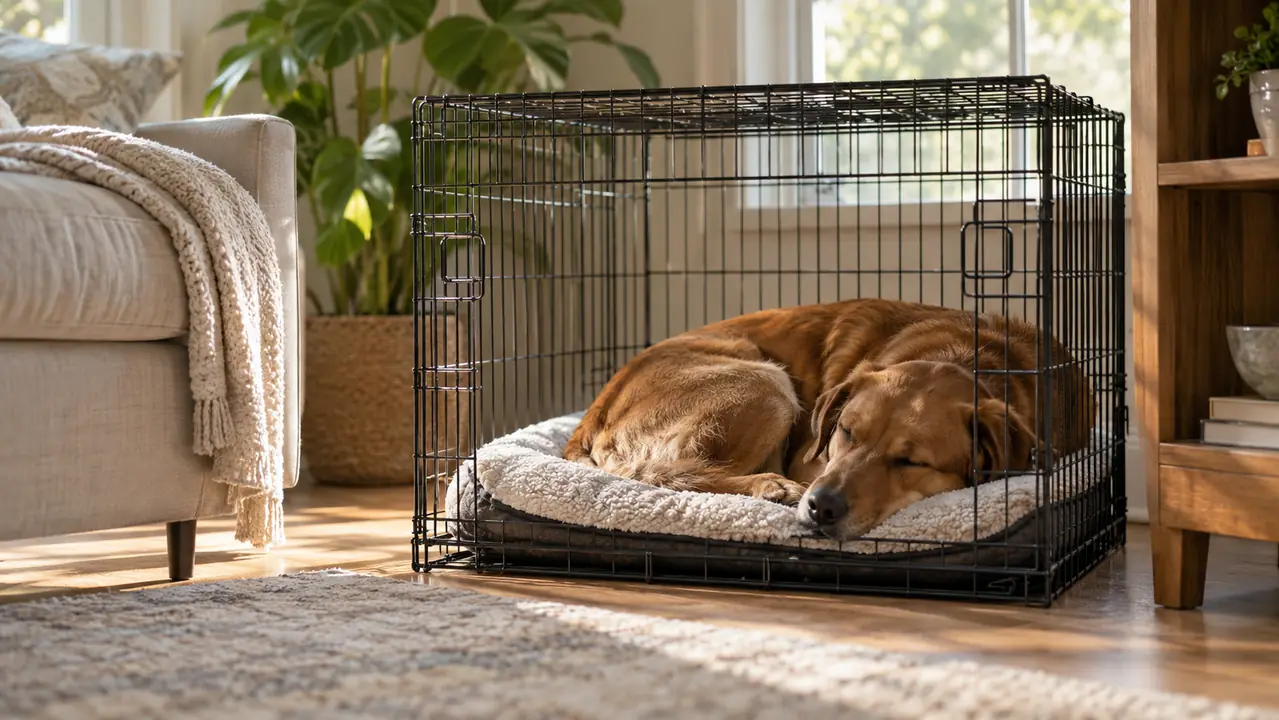
If your dog has ever eaten a shoe, a remote, and the corner of a couch cushion in a single afternoon, you already know the exact moment a crate stops being optional. That was our March. Cooper, the 55-pound lab mix we brought home from the county shelter, came with a foster note that said, in all caps, needs a den. The kind reading was that he liked small spaces. The honest reading was that he would remodel the living room the second we left. I spent a week reading crate reviews, narrowed it down to three models, and ordered the MidWest 36-inch single-door iCrate.
This is the long-term review, six months in, not the unboxing-day first impression. Cooper is now 61 pounds and fully crate trained, and that crate has been through every single night, roughly thirty daytime sessions a week, three road trips, one teething phase, and more fold-and-stow cycles than I can count. I kept track of the things that only show up after the novelty wears off: does the door still latch clean, does the floor hold up to a dog who digs at his bed, does it still fold flat when I need the trunk. Here is what I learned.
The Quick Verdict
Six months of nightly use and three road trips, and this is the crate I would buy again without shopping around. The divider panel alone is worth choosing it over a cheaper one-piece crate.
Amazon Check Today's Price →The Crate That Has Survived Six Months of a Teenage Lab
The MidWest 36-inch iCrate folds flat, goes together without tools, and has taken a teething 61-pound lab mix without a broken weld or a bent door. If you are crate training a medium-large dog, this is the one I would start with.
Amazon Check Today's Price on Amazon →How I've Used It
Cooper slept in the crate from night one, with the divider panel set so the space was just big enough for him to stand up, turn around, and lie down. That first week I fed him every meal through the door to build the association, and by day five he was walking in on his own at 9 p.m. like it was his job. The crate lives in the corner of the living room, and during the day we leave the door open so he can nap in it whenever he wants.
The routine six months later is identical. He goes in when we leave the house, he goes in at night, and on road trips the crate rides flat in the back of the SUV and pops up in minutes at the other end. I also use it as a quiet zone during holiday dinners, which my mother-in-law has finally stopped commenting on. It is the most-used piece of dog gear we own, and it is not close.
If a crate is going to fail, this is the schedule that finds it. Every night for six months, plus daytime sessions, plus about two thousand miles of travel with the crate folded and unfolded at every stop. That kind of use does not leave a lot of room for a weak hinge or a cheap latch to hide.
The first few nights were not magic. Cooper whined for about twenty minutes on night one, then quieted down and slept through. I set a timer and did not let him out when he cried, which is the hard part of crate training but also the part that works. By the end of the first week he was sleeping through the night, and by week two he would walk into the crate on his own when he saw me pick up my keys. The divider made that possible, because a space that fits a dog like a den feels safe, while a huge empty crate feels like a cage.
The Divider Panel Is the Feature That Sells This Crate
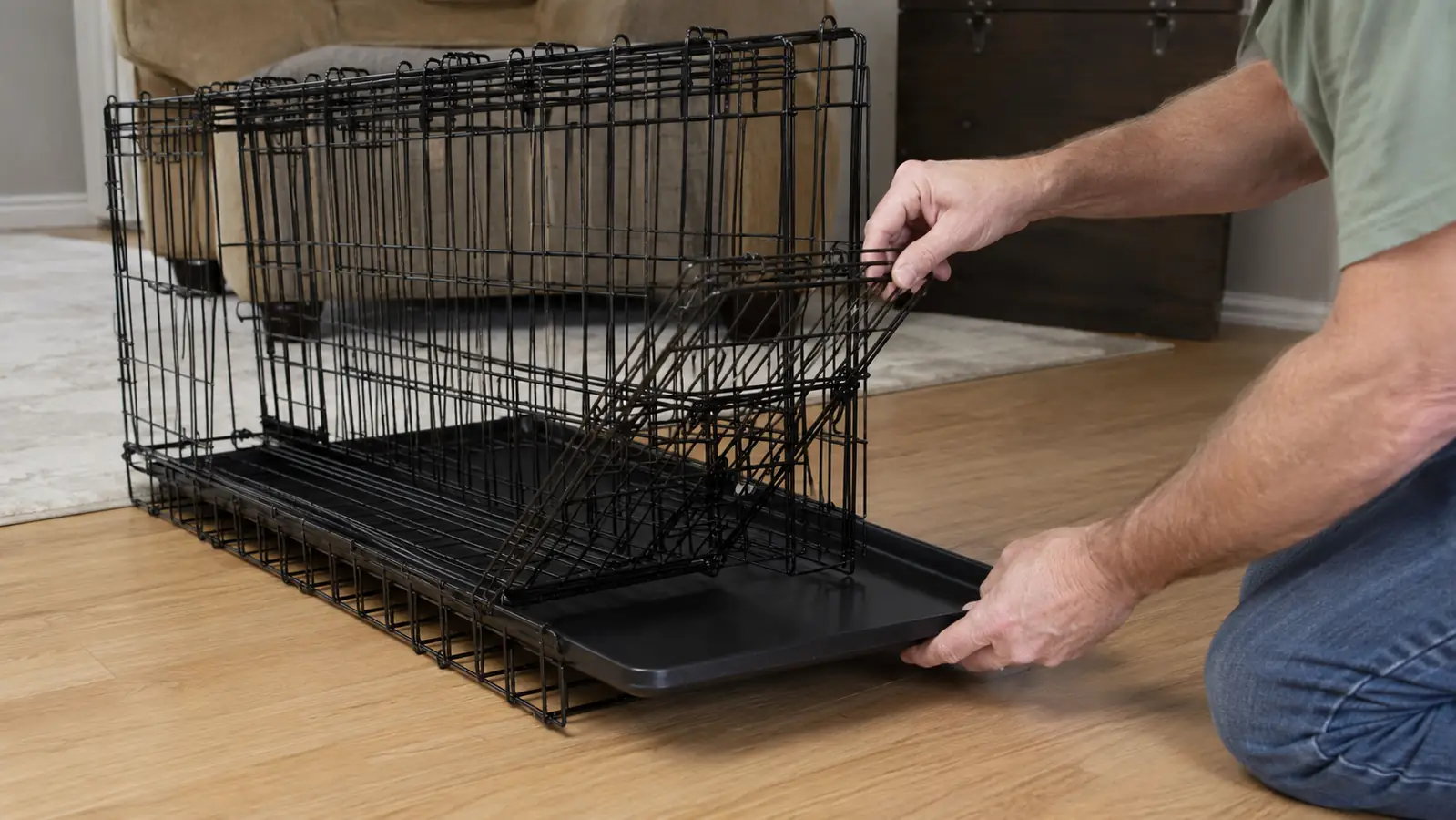
The 36-inch size is built for dogs in the 41-to-70-pound range, but you almost never start a puppy or a rescue at full size. The MidWest iCrate comes with a metal divider panel that slides in and clips into the crate walls, so you can shrink the interior while the dog grows. For crate training that is not a convenience, it is the whole ballgame. A dog with too much room will turn one end into a bathroom and the other into a bed, and then you are fighting a house-training battle you created yourself.
I moved Cooper's divider back roughly every three weeks as he grew, and each move took under a minute. The panel clips in at a few different depths, so the space grows in steps instead of one giant leap from puppy size to full size. That is the single feature that made crate training click for us, and it is the main reason I would not trade this crate for a cheaper one-piece wire model. If you are crate training a puppy, this panel is worth the price difference on its own.
Assembly, Folding, and the Doors You Use Every Day
Assembly out of the box took me about ten minutes with zero tools. The crate ships flat, you unfold the panels, hook the top, and snap the plastic base tray into place. The tray is one solid piece, which matters more than it sounds like it should. The budget crate we borrowed from a friend had a two-piece tray with a seam down the middle, and Cooper pried up the corner by week two. This one has no seam to grab, and six months later he has never gotten under it.
The doors are the part people touch every single day, so that is where I am pickiest. The front door has two slide latches that click into place, and six months in they still catch clean. The top handle is reinforced and lies flat against the roof when you are not carrying it. When I need the crate out of the way, it collapses to a few inches thick and leans against the garage wall. That is the difference between owning a crate and being owned by one, and it is the reason this one stays out of the way instead of living in the middle of the floor.
How It Held Up After Six Months
Here is what a crate actually endures that the first-week reviews never mention. A dog who flops his whole body against the wall at 2 a.m. A puppy who chews on whatever he can reach through the bars. A muddy dog shoved inside after a rainy walk. A thousand door slams from a human carrying groceries. After six months of all of that, the thing I did not expect is that the MidWest has no rattles. The welds on the corners are still tight, the door still closes without a lift, and the tray has no cracks even though Cooper digs at his bed every night before he settles.
The only real wear is cosmetic. The tray has a few scratches from his toenails, and the wire has a couple of bare spots where he chewed during the worst of teething. Nothing is bent, nothing is broken, and the door latch still has the same clean click it had in March. That is the honest long-term report. After six months of the heaviest use a household crate can see, the only damage is the kind you have to look for.
The road trips are where a folding crate earns its keep or fails it. Three times we have packed the crate flat in the back of the SUV, driven six hours, and set it up in a strange bedroom at the far end. Cooper sleeps in it at my parents' house and at the cabin, and the fact that it sets up the same way every time is a small mercy when you are tired and the dog needs to settle. The divider came out for the trips, since a full-size space is right for a grown dog, and the panel stored flat inside the crate without rattling.
Cleaning is part of the Sunday routine now. The tray slides out without fighting the frame, and once a week I carry it to the backyard, rinse it with the hose, and wipe it down with dish soap. The seams are where fur and kibble dust collect, and a quick swipe with a paper towel every few days keeps the crate from taking on a doggy smell. Six months in, it still looks like a crate from a household that cleans.
Six months of nightly crate time, a chewing puppy, and three road trips, and the welds are still tight and the door still latches with the same clean click.
What Goes Inside the Crate
The crate is only half the setup. What you put inside decides whether a dog treats it as a den or a holding cell. We started with a thin fleece mat instead of a plush bed, which was the right call, because a puppy still learning the rules will treat a thick soft bed like a toy. Cooper shredded his first mat in a week, and the cheap machine-washable crate mat we replaced it with has survived every night since.
For the first month we also draped a towel over the top and the back of the crate, turning the open wire box into a cave. Dogs like having their backs covered, and Cooper settled faster with the towel on. Once he was sleeping through the night reliably we took it down, but I would do the same for any new dog. The only other thing that lives in the crate is a rubber chew bone, which has outlasted every plush toy he owns. The water bowl stays outside overnight, because a sloshing bowl and a young dog who plays in water means a wet tray by morning.
The Tradeoffs Nobody Mentions in Week One
It is not a five-star-everything product, and I would not pretend it is. The wire is sturdy, but it is not escape-proof against a truly determined dog who learns to work the latches. Cooper never figured out the slide latches, but I have read enough owner stories to know some dogs do. If your dog has already escaped a crate, buy the heaviest gauge you can find and accept that a wire crate is a den, not a vault.
The second tradeoff is that the plastic tray is fine but not luxurious. It cleans up with a hose and a scrub brush, but deep scratches do show, and it is not a chew-proof surface if your dog decides to destroy it on purpose. And while the crate folds flat, it is still a thirty-pound chunk of metal that needs two hands when it is fully assembled. If you plan to move it between rooms every day, you will develop a system, and you will still occasionally thunk it into a doorframe.
One more honest note: the single door means the crate has one good side. Ours sits with its back against the wall, so that is all we use. But if your only spot is in the middle of a room or under a window you reach from the side, you will be reaching around the frame every day. The double-door version exists for that reason, and it is worth the difference if the crate will not sit against a wall.
Alternatives I Considered
Before I settled on the MidWest, I looked hard at the cheaper folding crates that sell for about half as much. The one I borrowed from a friend had the two-piece tray Cooper pried loose, and its door latch already needed a firm yank to close by the time I gave it back. I also considered a heavy-duty escape-proof crate with a thicker frame, but at 61 pounds Cooper is not an escape artist, he is a standard enthusiastic adolescent, and that crate would have cost more than double for weight I do not need.
For this dog, in this house, the MidWest 36-inch sits in the middle of the market and that is exactly why I recommend it. It is not the cheapest crate and it is not the toughest crate, but it does everything a normal family needs without charging for features only a professional kennel would use. If I had a determined chewer or an escape artist, I would pay up for the heavy-duty model. For an ordinary, well-meaning dog, this is the sweet spot.
What I Liked
- Assembles in about ten minutes with no tools
- Divider panel shrinks the space for puppies, which makes house training faster
- Folds flat for storage and travel, fits in the back of an SUV
- Two slide latches on the front door still snap clean after six months
- One-piece plastic tray is easy to clean and cannot be pried up
- Sturdy welds, no rattles, survived a chewing puppy
Where It Falls Short
- Wire is sturdy but not escape-proof for a dog who learns the latches
- Plastic tray scratches and shows toenail marks over time
- Heavy when fully assembled, awkward to move with one hand
- Cheaper crates cost half as much, and a serious escape artist needs a heavier gauge
Who This Is For
Buy the MidWest 36-inch iCrate if you have a medium-large dog in the 41-to-70-pound range, especially a puppy or a rescue you are house training. It is the right crate for a family that wants a solid everyday crate, one that goes together without a toolbox, grows with the dog thanks to the divider, and folds down when you need the space. If you are crate training, the divider alone makes it worth choosing over a cheaper one-piece crate that costs a little less and gives you a lot less.
Who Should Skip It
Skip it if your dog has a proven record of escaping wire crates, because you need a heavier gauge and a more complicated latch. Skip it if your dog is over about 70 pounds, because the 36-inch is sized for medium-large breeds and you will want the 42- or 48-inch version. And skip it if you need something you can pick up and move with one hand every day, because this crate is sturdy and that sturdiness has a weight to it. For a calm, fully grown, already-house-trained dog, you can save the money with a cheaper folding crate, you just give up the divider and the sturdier tray.
Six Months In, It Is Still the Crate I Would Buy Tomorrow
After six months of nightly use, three road trips, and one teething lab mix, the MidWest 36-inch iCrate is the one piece of dog gear I have never regretted. If you are crate training a medium-large dog, check today's price.
Amazon Check Today's Price on Amazon →