
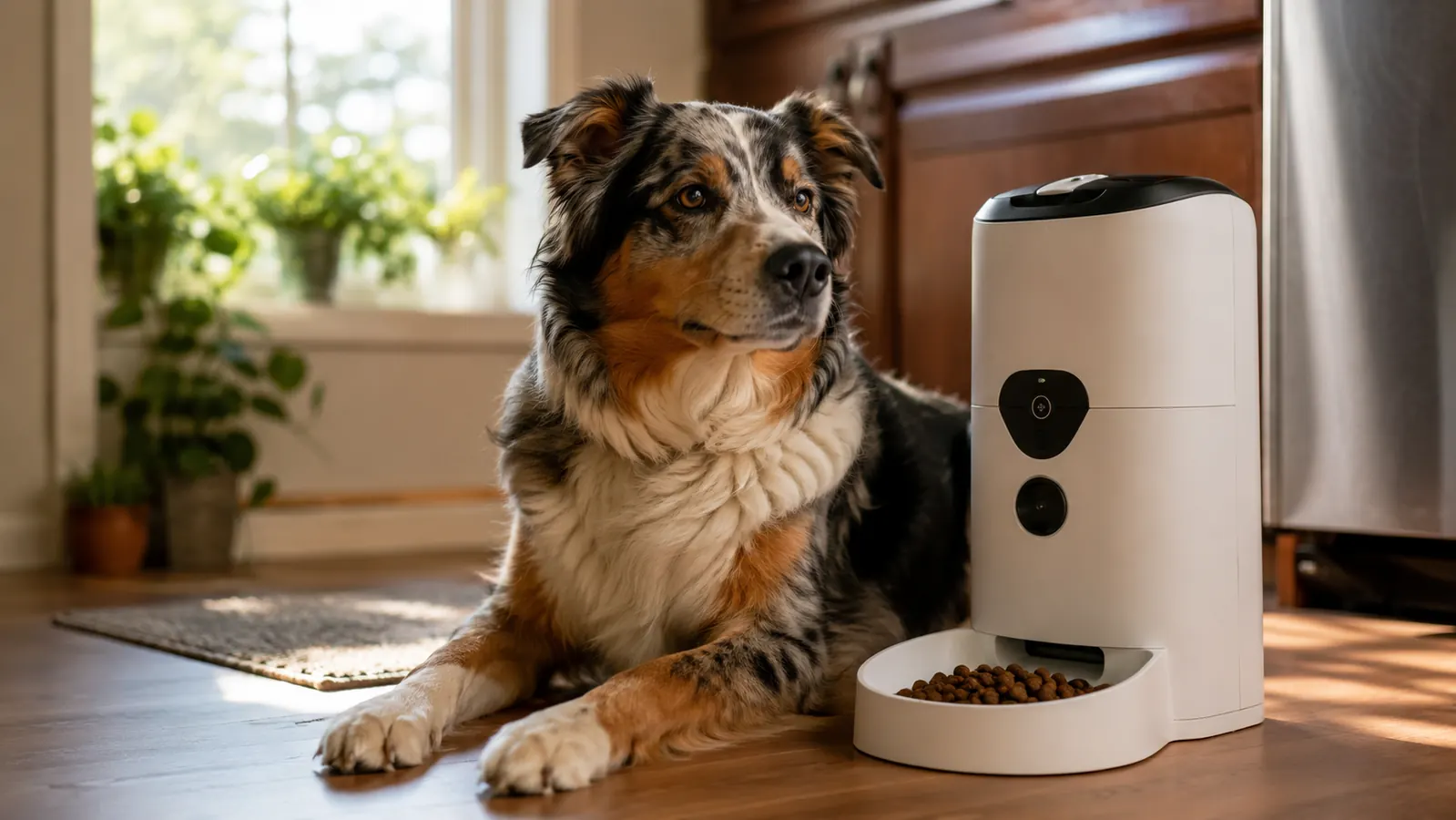
For months, my mornings started the same way. I would wake up already behind, and Duke would be sitting by his bowl with that look, the one that says you have failed the most important job in the house. He is a 70-pound Lab and Shepherd mix, and when I was late he did not bark. He just sat there, and somehow that was worse. I had tried setting an alarm. I had tried leaving his kibble in a bowl the night before. I had tried convincing myself I would wake up on time tomorrow. None of it worked.
That is the problem this PetSafe automatic feeder was built to solve, and after six months of letting it feed Duke on a schedule, I can tell you exactly where it earns its keep and where it does not. It replaced my worst habit, the rushed scoop at 6:15 in the morning, and it gave Duke the one thing my memory could never promise, a meal at the same time every single day.
The Quick Verdict
After six months, this feeder has been more reliable than I am. It is not perfect, but for a household where nobody is home at noon, it has earned its spot on the kitchen counter.
Amazon Check Today's Price →The feeder that ended my 6:15 a.m. scramble
If your dog gets fed at a different time every day because your day does, this is the fix. Six months in, Duke's meals land at the same time whether I am home or not.
Amazon Check Today's Price on Amazon →How I've Used It
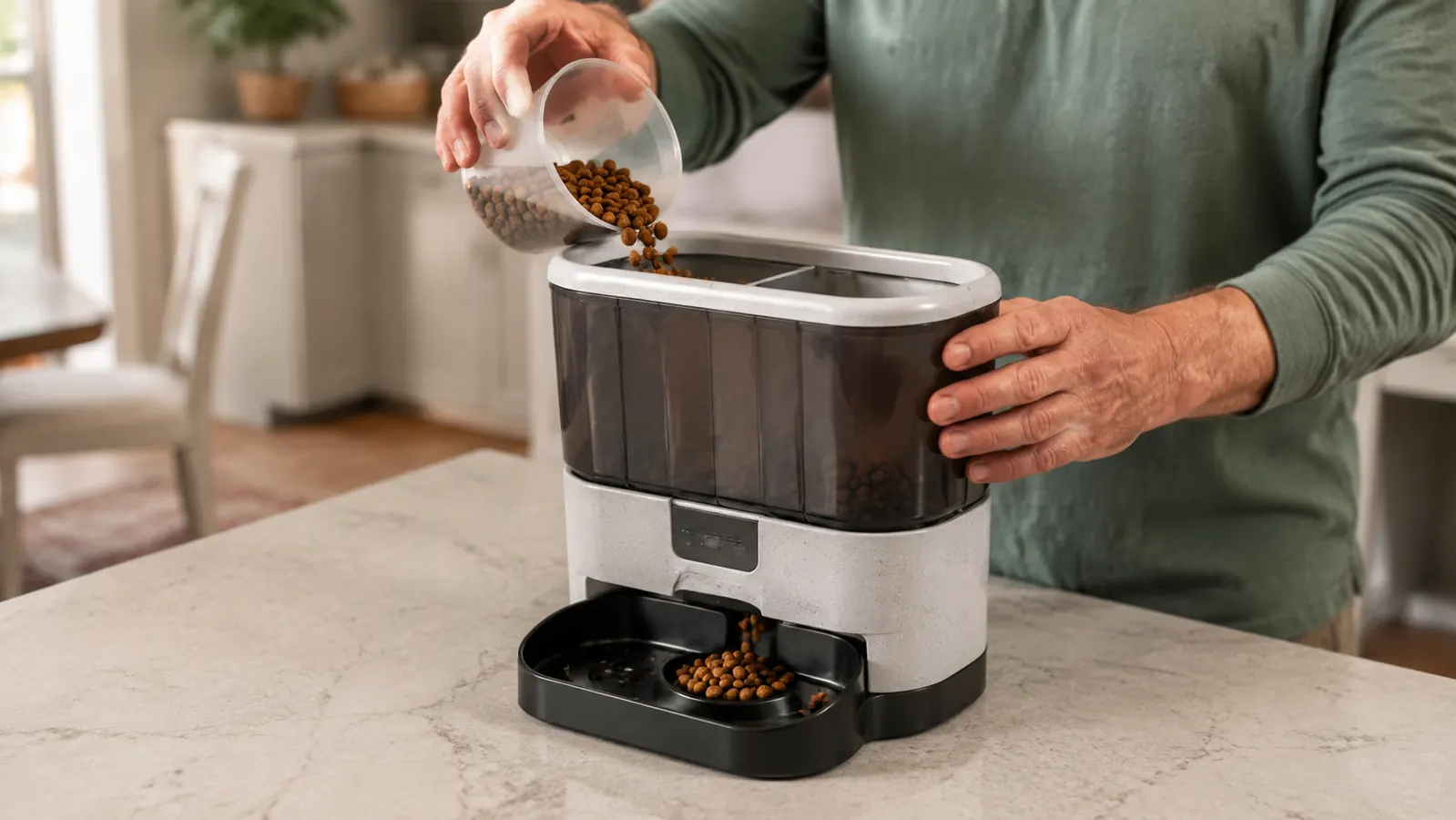
Here is my setup, in case it helps to picture how the thing works in a real kitchen. I set Duke's breakfast for 6:30 a.m., a measured snack for noon, and dinner for 5:30 p.m. Each compartment holds a portion, the lid on top rotates over the dish at the programmed time, and my only job is keeping the drum full. I fill it every two to three days, press the lock button, and my part is done.
It runs on batteries, so it does not need to sit beside an outlet, and the display is simple enough that I set the whole schedule in about five minutes the first time. Changing a meal time takes under a minute. I am not a gadget person. If I can program this, you can.
For portion size, I had to do a little math the first week. The feeder holds 40 ounces across its compartments, and Duke eats about 4 cups of kibble a day, which comes to around a pound of food. A full drum gets him through two and a half days. I fill it Sunday evening and Wednesday morning, and both fills together take about five minutes.
The First Week: Getting Duke to Trust the Lid
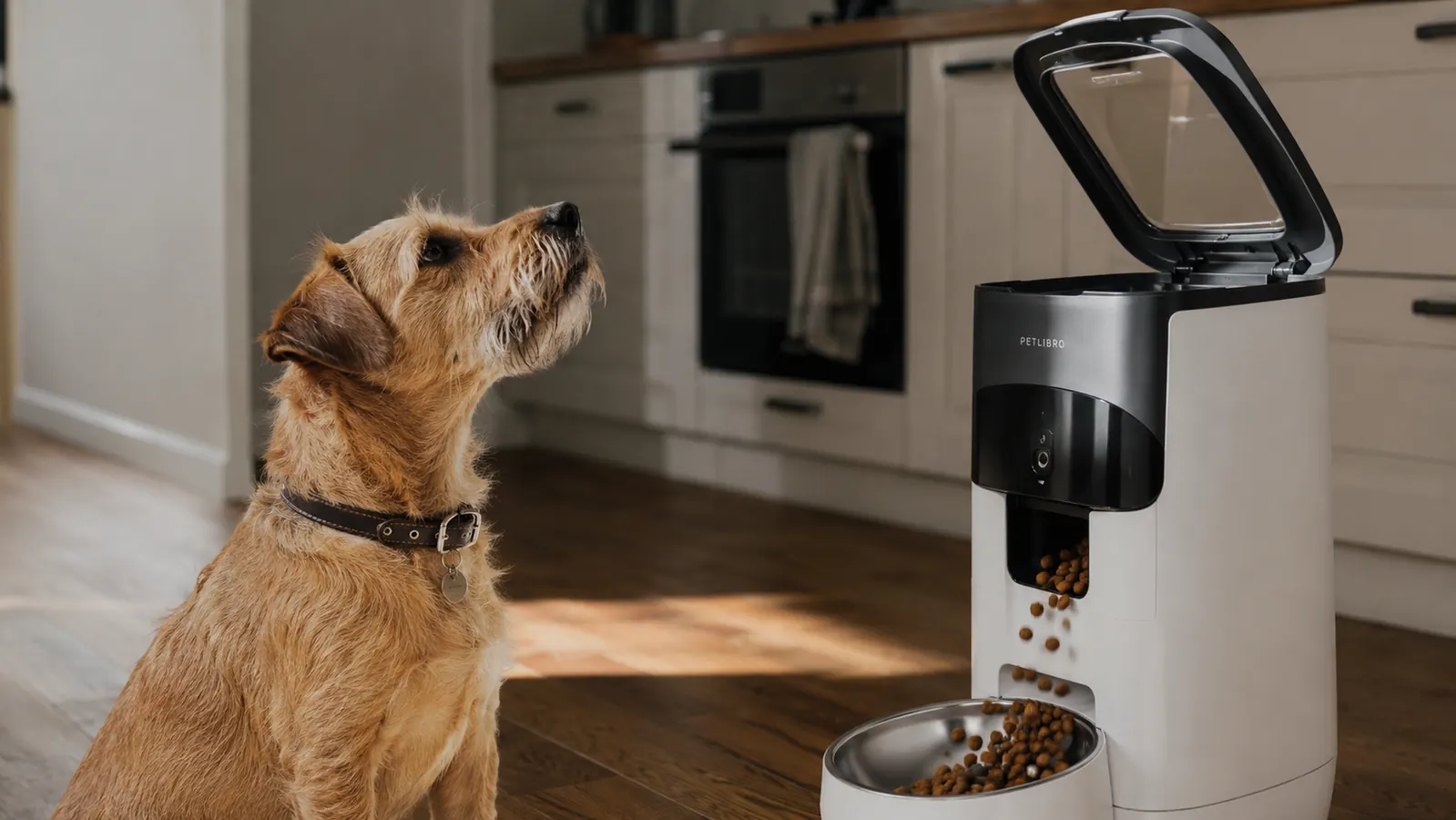
The first morning, I did not trust it any more than Duke did. I set the feeder the night before, double-checked the display, and still woke up early to watch the 6:30 meal drop. The lid clicked, rotated, and opened over the dish, and Duke looked at it like it had personally betrayed him. He sniffed the kibble, looked back at me, and only then started eating. By day three he was waiting in front of it.
Here is the part that surprised me. The lid opens with a mechanical click, and that click has become a cue. Duke now lies down a few feet from the feeder about five minutes before it is due to go off, the way he used to follow me to the kitchen. The feeder trained both of us. I no longer wake up wondering whether I fed him, because the schedule is printed on the display and the dog is standing by the bowl.
One warning for the first week: do not change the schedule mid-meal. I bumped a button once while the feeder was locked and ended up serving Duke's lunch an hour early, which taught me to press the lock button after every change. Minor stuff, but worth knowing.
Duke stopped standing guard over the kitchen at four in the afternoon, and our vet noticed his weight held steady before I ever mentioned the feeder.
What Actually Changed, Month by Month
The real value of a feeder like this only shows up slowly, which is why a six-month review feels different from a first-impression one. In the first month I was still watching it like a new employee, checking every morning the way I used to check Duke's water bowl. By month three I had stopped thinking about it, and by month six I realized I had gone entire weeks without touching the schedule. That quiet fade is the whole story, and it is worth unpacking.
In February, the month I bought it, I stood there and watched the lid open every single morning, as if the feeder needed an audience. By April I was filling it every two or three days and trusting it the rest of the time. The schedule I set in February is still the schedule it runs today. I have not had to change a single meal time since, and I have not wanted to.
The other change crept up on me. Somewhere around month four, I noticed I had stopped saying I needed to get home to feed Duke. I had stopped watching the clock at dinner. The feeder did not just feed him, it took the mental load off me, and that is the part you cannot measure from the box.
Portion Control and the Consistency Duke Now Lives By
The biggest change is not the hardware, it is what the schedule does to Duke. A dog that eats at the same time every day stops hovering. He knows the lid opens at 6:30, and he has stopped standing guard over the kitchen at four in the afternoon. Our vet noticed the difference before I mentioned the feeder. Duke is the same weight he was in March, and for a middle-aged dog, steady is exactly what you want.
The portion control is real too. I set each compartment to the amount I want, and the feeder never overscoops on a busy morning. Duke gets his meals divided across the day, the 40-ounce capacity holds enough for two and a half days, and I do not measure a single scoop by hand anymore.
I should be specific about what portion control means here, because it is not the same as the gravity feeders I used to see at my aunt's house. A gravity feeder pours from a hopper whenever the bowl dips below full, so the dog decides the schedule and the amount. This one releases one compartment at a time, on the timer, so Duke gets exactly what I measured, no more. If your vet has told you to trim a quarter cup, you can do that in thirty seconds.
The Numbers That Matter: Batteries, Portions, and Fill Cadence
Let me give you the numbers I actually use, because the manual buries them. The feeder takes four D batteries, and in my house those last roughly two months. I now change them on the first Saturday of every other month instead of waiting for the low-battery beep, because that beep has a talent for showing up at the worst possible moment. The display does not lie, but it also does not nag, so a little calendar discipline beats a surprise.
The portion buttons take some getting used to because they are numbered, not marked in cups. I figured out my setting by weighing Duke's breakfast for three days in a row with a kitchen scale, then matching the dial to that amount. Now a vet-recommended change, say a quarter cup less, takes about thirty seconds to dial in. That is the whole point of a portioned feeder, the ability to change the amount without changing the habit.
And the fill cadence is simple math. Duke eats around four cups a day, which is roughly a pound of kibble, and the 40-ounce drum holds about two and a half days of food for him. So I fill it Sunday evening and Wednesday morning, about five minutes each time. For a smaller dog or a cat eating a cup or two a day, a full drum would stretch a week or more, which makes the same machine work for a much smaller appetite.
Travel, Odd Hours, and the Nights I Am Not Home
The feeder earns its keep most on the days I would otherwise get wrong. When I drive my daughter to an early practice and the house is empty at breakfast time, Duke still eats at 6:30. When I am gone overnight and my mother-in-law comes by to check on him, she does not have to guess his schedule. It is printed on the feeder, and the feeder does not forget.
It has also quietly changed our weekends. I used to sleep in and feed Duke late, which meant he was hungry and restless by noon. Now the weekend schedule is the same as the weekday one, and he is calmer because his body knows what is coming. That consistency has been worth more to me than any feature on the box.
Cleaning: The Part Nobody Mentions
Here is the honest part. The PetSafe feeder is plastic, and it needs a proper cleaning every couple of weeks or the compartments pick up a greasy film, especially around the lid where Duke has explored every seam. The tray and compartments come apart and go in the sink. The base, the part with the motor and the display, does not go in water. You wipe that down with a damp cloth.
That is not a dealbreaker, but it is a job, and I want you to hear about it before you buy, not after. Give yourself twenty minutes every other weekend. If you are someone who will never take it apart to wash it, this might not be the feeder for you, and it is better to know that now.
One more cleaning note. The lock button and the display are on the base, and I have learned to keep water away from them. When I wash the compartments, I dry them completely before snapping them back in, because a damp tray makes the kibble stick. It takes an extra two minutes and saves a lot of scrubbing later.
What I'd Change, and the Feeders I Considered Instead
Three small frustrations keep this from a perfect score. First, it only handles dry food. I mix a spoonful of canned food into Duke's dinner, and I add that at serving time, which means the feeder does the kibble and I do the wet. Second, the battery indicator is easy to ignore, and I learned the hard way to swap the batteries before a trip. Third, the lid is a rotating one, and a determined dog can learn to nudge it. Duke never did, but plenty of owners report a dog that figured it out.
Before I settled on this one, I looked at a gravity feeder, where a hopper keeps a bowl full, and at a Wi-Fi feeder I could control from my phone. The gravity feeder would not fix the schedule, it just keeps a bowl topped up. The app feeder cost three times as much for a feature I did not need, since my problem was not remote control, it was remembering to feed the dog at all. This one runs on a simple timer, which is exactly the job I needed done.
If I had a multi-cat home, I might have looked at a feeder with a microchip sensor, so the greedy cat could not eat the shy one's meals. Our household has one dog and one cat who refuses to touch dry food, so the PetSafe's five-meal timer was the right amount of machine. Know what your household actually needs before you spend on extras.
The Bottom Line After Six Months
I have owned this feeder since the end of February, which means it has fed Duke through spring shedding, a vacation week, and a stretch where I worked late every night. It has missed exactly zero scheduled meals in that time. The only failures were my own, the forgotten battery swap and the button I bumped.
If I am being fully honest, the feeder is not exciting. It is a plastic box that opens a lid on a timer, and that is exactly why I trust it. Six months in, I have stopped thinking about it, which is the highest praise I can give a piece of pet gear.
What I Liked
- Meals land at the same time every day, home or not
- Measured portions stop the overscoop on busy mornings
- Runs on batteries, so placement is flexible
- Five minutes to program, and easy to change
- Fills every two to three days, not twice a day
Where It Falls Short
- Dry food only, wet food still has to be added by hand
- Needs disassembly to clean every couple of weeks
- Battery level is easy to ignore before a trip
- A determined dog may learn to nudge the rotating lid
Who This Is For
Buy this feeder if your pet eats on a schedule that your memory cannot keep, if you leave the house before the pets are up, or if two people feed at different times and the dog plays you against each other. It is also a good fit if your cat grazes all day and your vet wants portioned meals. For us, the real win is the middle of the day, when nobody is home and the feeder holds the line.
If you have a dog who inhales food in one gulp, this is not a puzzle feeder, it will not slow him down. What it does is put the meals on rails so he can count on them. Duke is a fast eater and the feeder did not change that, but it did change the anxious circling he used to do when dinner ran late.
Who Should Skip It
Skip it if your pet eats wet food, canned food, or a raw diet, because this feeder does dry kibble only. Skip it if you have a dog big enough to knock a plastic feeder off a low table, or a chewer who works latches for sport. And if the idea of taking it apart every couple of weeks already makes you sigh, a bowl and a measuring cup will serve you just as well.
There is also a simpler option worth naming. If you are home most of the day and your only problem is portion size, a measuring cup and a bowl fix that for free. The feeder earns its place when the schedule is the problem, not the portion. My sister has a cat who grazes and she has never needed one. I respect that.
Six months in, I would buy it again
It will not feed wet food and it needs a wipe-down every couple of weeks, but the consistency it gave Duke is worth far more to me than the mornings it cost me. If your dog lives by the clock, this feeder keeps the promise.
Amazon Check Today's Price on Amazon →