
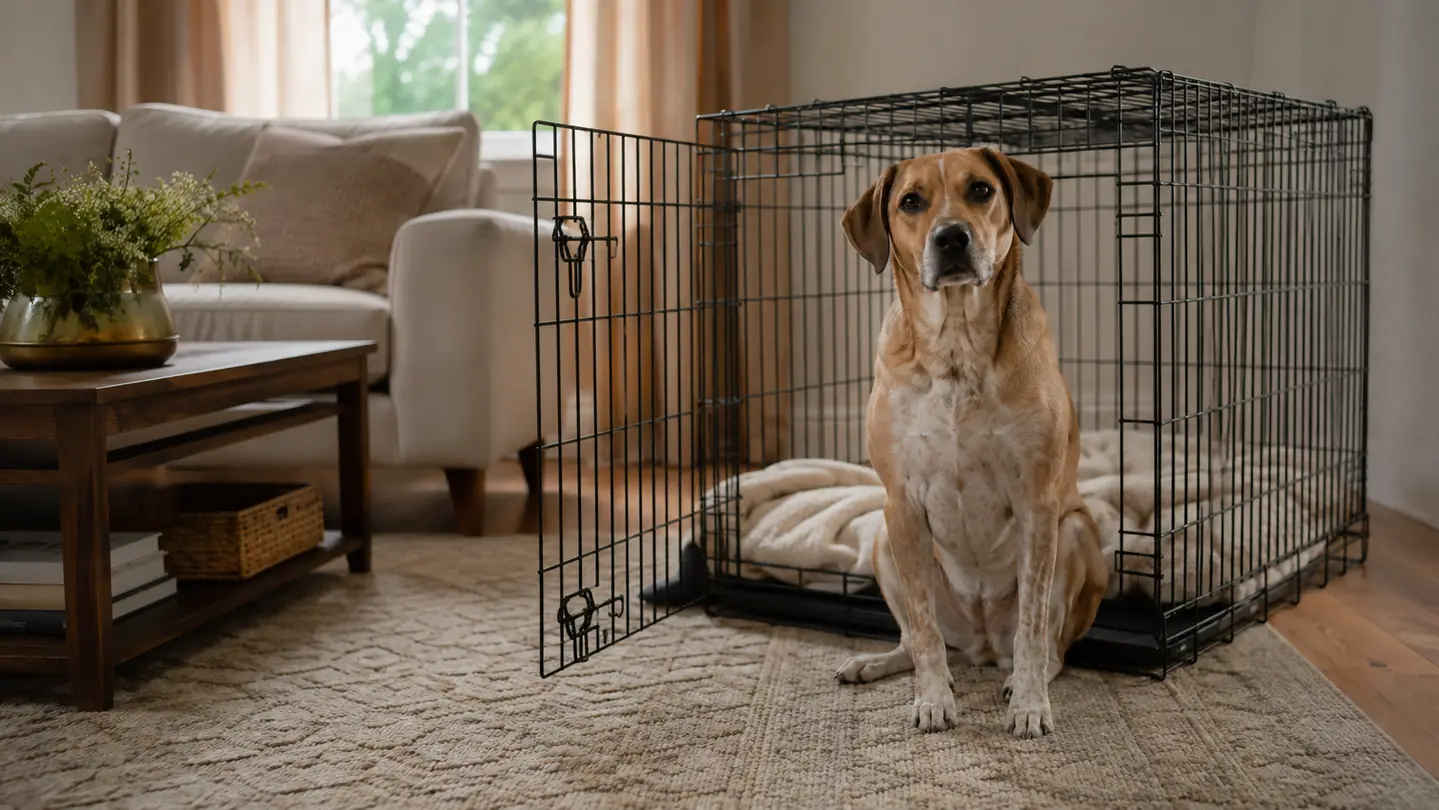
Back in March we brought home a 16-month-old hound mix named Mickey from a rescue transport. He was a sweet, wiggly dog, house-trained enough, and completely lost in a real house. The first time we left him alone for an hour, he scratched the baseboard, howled, and tipped over his water bowl. By the end of the first month he had ruined three rugs, bent a cheap baby gate, and earned a note from our neighbor about the noise.
I'm not a professional trainer, and I'm not writing this from a training manual. I'm an ordinary pet owner who tried everything that did not work first. We left Mickey loose while we ran errands and came home to a shredded couch cushion. We bought a flimsy crate from the big-box store and watched him push it halfway across the kitchen floor. We followed advice from people whose dogs had clearly never spent a single day alone in an apartment.
What finally worked was a real crate, the Midwest iCrate 36-inch single-door model, plus a simple routine that took about three weeks to stick. This is that routine, step by step, including the mistakes to avoid. If you have a puppy who cries at night or a rescue who treats a crate like a cage, this is the plan that got our dog comfortable with his. The same steps work whether you are starting with a puppy or an adult rescue, so do not worry about which one you have.
A Crate That Grows With Your Dog
The Midwest iCrate comes with a divider panel so you can make the space small for a puppy and expand it as the puppy grows. It folds flat for travel, and the plastic tray slides out for cleaning. This is the crate we used every day for six months, and it is still the one I would buy again.
Amazon Check Today's Price on Amazon →Step 1: Size It Right and Set the Divider Panel
The single biggest mistake people make with a crate is buying one that is too big. A dog will happily sleep on one side and go to the bathroom on the other, and then you are teaching them to mess where they sleep. That is the exact opposite of what a crate should do. The rule is simple: the crate should be big enough for your dog to stand up, turn around, and lie down flat, and no bigger.
That is why the divider panel on the Midwest iCrate matters so much. Our 36-inch model is sized for dogs in the 41 to 70 pound range, which fit Mickey, about 48 pounds, nicely. If you are starting with a puppy, you can install the divider to make the space smaller now and move it back as the puppy grows. The panel snaps into the middle of the crate and takes about a minute to move, so there is no excuse to keep the space too big. You buy one crate that works for the whole first year instead of two or three sizes.
Set the crate up in the room where the family spends the most time, not in a quiet corner of the basement. Dogs are pack animals, and a crate parked beside the couch gets accepted far faster than one hidden away. Put a soft bed or a folded blanket inside, leave the door open, and let your dog explore it on their own for the first day. Do not close the door once in that first afternoon.
Step 2: Make the Crate the Best Room in the House
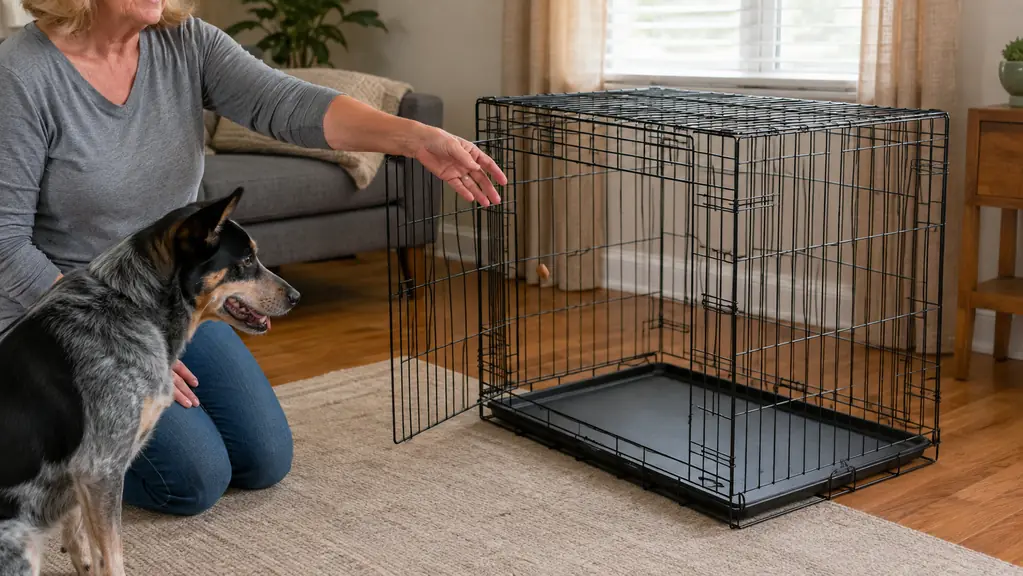
The goal of this step is to convince your dog that the crate is a good place, not a jail cell. The fastest way to do that is with food. Start by feeding meals with the bowl just outside the open door. After a couple of days, set the bowl just inside the door. After a few more, move it to the back of the crate. Before long your dog will walk in on their own at dinner time without any coaxing. It took Mickey four days to start going in on his own, and two of those days he was really only going in for the bowl, but that was fine. Habit comes before trust.
Along with meals, I tossed a high-value treat into the crate several times a day. Every time Mickey went in, he found something good. I never closed the door during this phase, and I never lured him in and then slammed the door behind him. The closed door has to earn a dog's trust before it means anything, and that trust starts with meals and treats that appear out of nowhere.
One small thing helped us a lot. I stopped calling it a cage and started calling it his crate, in a cheerful voice, every single time. It sounds like nothing, but the word you use sets the tone. Dogs read our tone better than our vocabulary, and if the crate is where good food and calm praise happen, the dog stops treating it like a trap.
Step 3: Teach a Cue With Short, Happy Sessions
Once Mickey was walking into the crate on his own, I added a word. I tossed a treat inside, said 'kennel' as he stepped in, and gave him a second treat the moment he was inside. After a dozen repetitions he connected the word to the action. You can use any word you like: 'crate', 'kennel', 'bed'. Just use the same one every single time and make sure everyone in the house uses it too. I wrote the word on a sticky note by the crate so we would not drift.
Next I started closing the door for a few seconds at a time. I would close it, give him a treat through the wire, open it, and act like it was no big deal. Then I closed it for ten seconds, then thirty, then a minute. The only rule is to close the door for as long as the dog stays calm. If Mickey whined, I waited for a quiet moment and opened then. I never opened the door while he was crying, because that teaches a dog that fussing is what opens the door.
Keep these first sessions to five or ten minutes and run them when the dog is relaxed, not right after breakfast when they want to nap and not right after a walk when they want to play. Timing matters more than people think. A tired but not wired dog learns the crate far faster than an overstimulated one.
Step 4: Build Real Time With the Door Closed
After a few days of short closed-door sessions, I started working up to longer stretches. I would close the door and sit on the couch reading for five minutes, then ten, then twenty. Then I stepped into the kitchen where he could see me, and finally out of the room for a minute or two. Every time I came back, I waited for him to be calm before I let him out, so the reward was for quiet, not for noise.
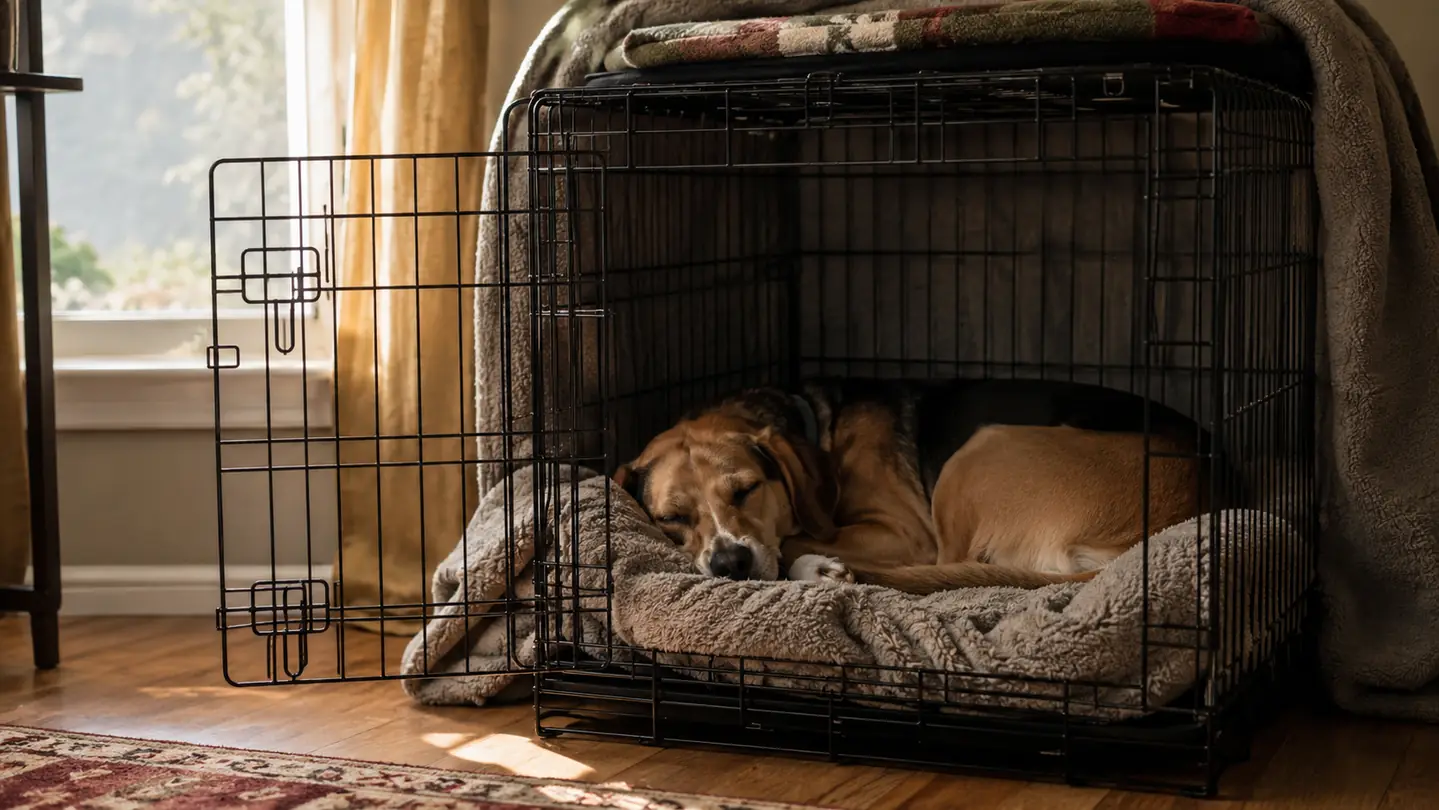
The big turning point for us was moving meals into the crate with the door closed. Mickey ate his breakfast and dinner inside the crate, with the door shut, while I sat nearby. After he finished, I waited a few minutes, let him out, and took him straight outside for a bathroom break. Eating in the crate does two jobs at once. It makes the crate feel safe, and it puts a full belly and a potty break on the same schedule. That full-belly rhythm is also the fastest way to teach a puppy where to do their business, because a puppy who just ate almost always has to go within a few minutes.
I kept the sessions short enough that he never got worked up. Ten or fifteen minutes of quiet, then out. A crate training session that ends in panic sets you back a day, and a session that ends in a nap moves you forward two. When in doubt, end on a win.
Step 5: Set a Schedule and Stick to It
Crate training is really potty training plus quiet time, and both run on a schedule. A useful rule of thumb: a puppy can hold it for about one hour for every month of age, plus one, up to a reasonable limit. So a 3-month-old puppy needs a middle-of-the-night bathroom trip for the first few weeks. Set an alarm, take the puppy out on a leash, let them do their business without playing, and put them right back in. Yes, that means getting up once in the middle of the night for a few weeks. It is worth it, and it does not last long.
For the workday, I built up alone time slowly. The first week I left Mickey for twenty minutes while I ran to the store. Then an hour, then a couple of hours. I always left him with something safe to chew so he had a job to do, and I never used the crate as punishment for a mistake on the rug. The crate is a bedroom, not a timeout. That single rule is what kept him from ever fearing it.
Consistency is the whole game. The same wake-up time, the same feeding time, the same bedtime, the same potty breaks. Dogs read routines faster than they read words, and the more predictable the day is, the faster the crate becomes just another safe, boring part of it. It took Mickey about three weeks to get there, and most of that was us, not him.
What Else Helps
A few extras made a real difference for us. A stuffed chew toy, a rubber toy packed with a smear of peanut butter (check the label for xylitol, which is toxic to dogs), gave Mickey something positive to focus on when the door closed. A lightweight crate cover turned the crate into a cozy den during his afternoon nap and blocked out the household noise that made him perk up. Neither is required, but both speed things along. Skip toys with small parts that could break off, and take the toy away if your dog starts chewing pieces off it.
Exercise matters too. A tired dog is a calm dog, and a long walk or a solid game of fetch before crate time makes the whole process faster. We also moved the crate into our bedroom for the first two weeks so Mickey could hear us breathing at night, which settled him far faster than being alone in the kitchen. Once he slept through without fussing, we moved it back to the living room. We kept a spare sheet on the floor under the crate for the first week, just in case, and we never once had to wash it.
I also learned to sit on my hands during the first few minutes of quiet whimpering. As long as I knew Mickey was safe and had been out recently, I let the whine run its course instead of rushing in, and it always stopped on its own. Every time I ran to him mid-cry, I taught him that crying worked.
What to Do If It's Not Working
If your dog is still crying hard after two weeks, go back to the last step where they were calm and spend a few more days there. The most common problem is moving too fast, not a stubborn dog. For a dog with real separation anxiety, talk to your vet about a plan. A crate is a tool, not a cure, and it should never be used to make a panicked dog stay alone for hours.
Check the basics before you blame the dog. Is the crate too big? Is it too hot or too cold? Is the dog getting enough exercise and bathroom breaks? Nine times out of ten, the answer to a crate training stall is one of those, not a bad dog. And remember that most dogs take somewhere between one and three weeks to settle in. If yours is on the slower end, that is normal.
Three weeks in, Mickey walked into his crate on his own at bedtime and curled up before I said a word. That is when I knew the routine was working, not the crate magic.
Start With a Crate You Won't Outgrow
The divider panel on the Midwest iCrate is the reason we never bought a second crate. If you are about to bring home a puppy or a rescue, this is the one I would buy again. Check today's price and see if the 36-inch size fits your dog.
Amazon Check Today's Price on Amazon →