
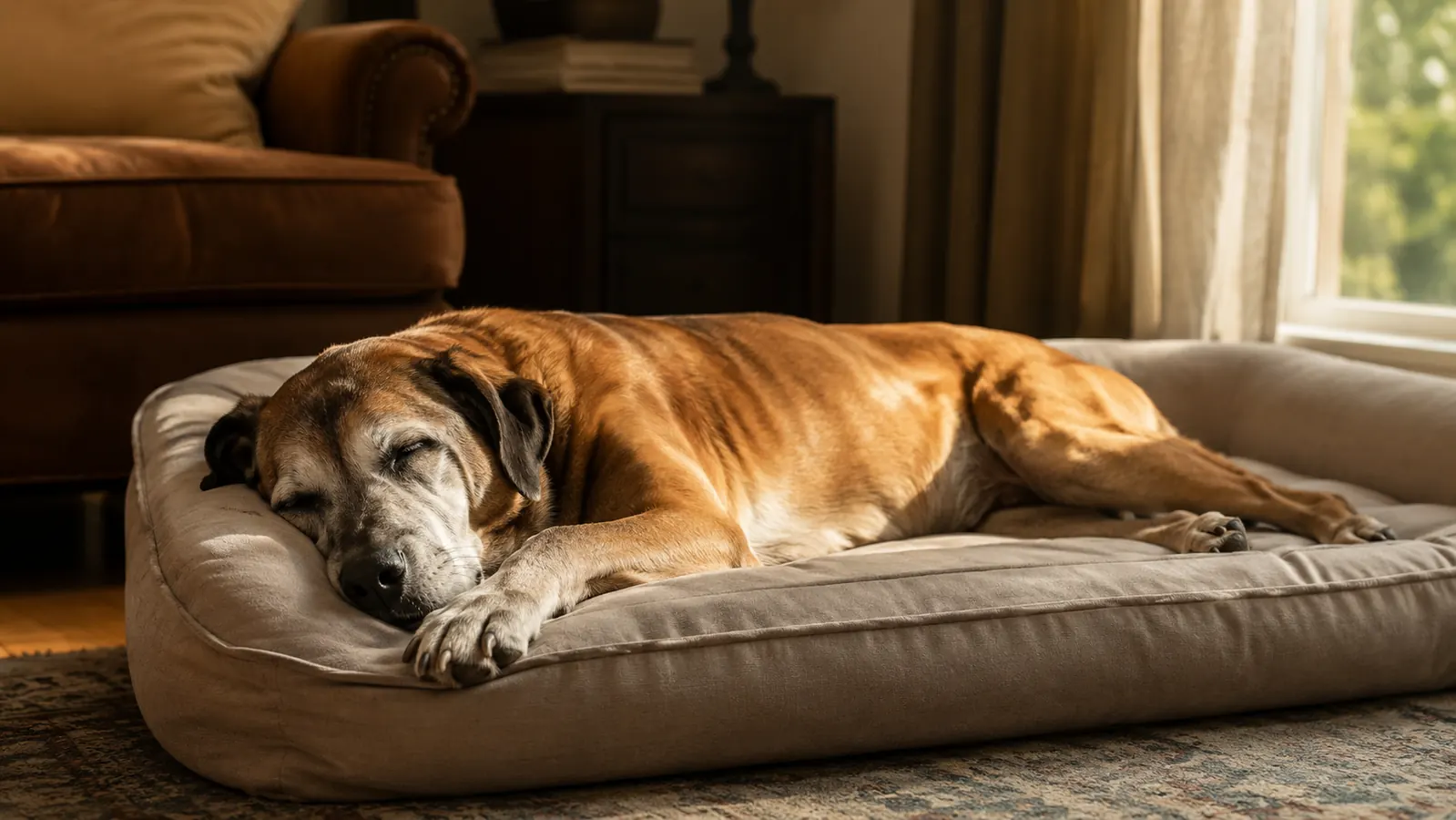
My old dog Rocky turned twelve this spring, and the change crept up slowly enough that I almost missed it. He still gallops for his dinner bowl, but the gallop takes a second longer now, and when he gets up from the floor he does a little pre-stretch first, back legs trembling, that he never used to do. The vet says it is arthritis in his hips. Seventy-eight pounds and a lifetime of launching off the porch will do that to a Labrador. She did not say much about beds, but she did not need to. I watched him circle the flat cushion bed we have had for years, circle it again, and finally flop down with a sigh that was half relief and half give-up. That cushion was not supporting him anymore, and the first bed that actually did was the Furhaven Jumbo XL.
I am not a vet and I am not a dog trainer. I am just the person who buys the gear, so when I set out to find a real orthopedic bed, I had to learn what the word actually means. The pet aisle is full of beds with orthopedic printed on the tag and not much underneath to back it up. This guide is the checklist I wish I had: how to measure your dog, what foam to look for, what shape matches how your dog really sleeps, and what cover will survive a wash cycle. I will tell you what the Furhaven bed does well and where it falls short.
The bed that finally got my senior Lab off the floor
The Furhaven Jumbo XL pairs an egg-crate comfort layer with a solid orthopedic foam base, has a removable washable cover, and carries nearly eighty thousand owner ratings at 4.4 stars. It is the bed that ended Rocky's nightly circling.
Amazon Check Today's Price on Amazon →Step 1: Measure Your Dog Before You Shop
Every orthopedic bed listing is sized by weight range, and every dog is shaped a little differently, so the weight chart is only a starting point. The measurement that matters most is length, from the tip of the nose to the base of the tail, with your dog standing normally. Rocky measures 36 inches that way. Most manufacturers want you to add six to twelve inches of extra room, so a 36-inch dog should be looking at a bed around 42 to 48 inches long. That lands a big Labrador squarely in the Jumbo or Jumbo XL class.
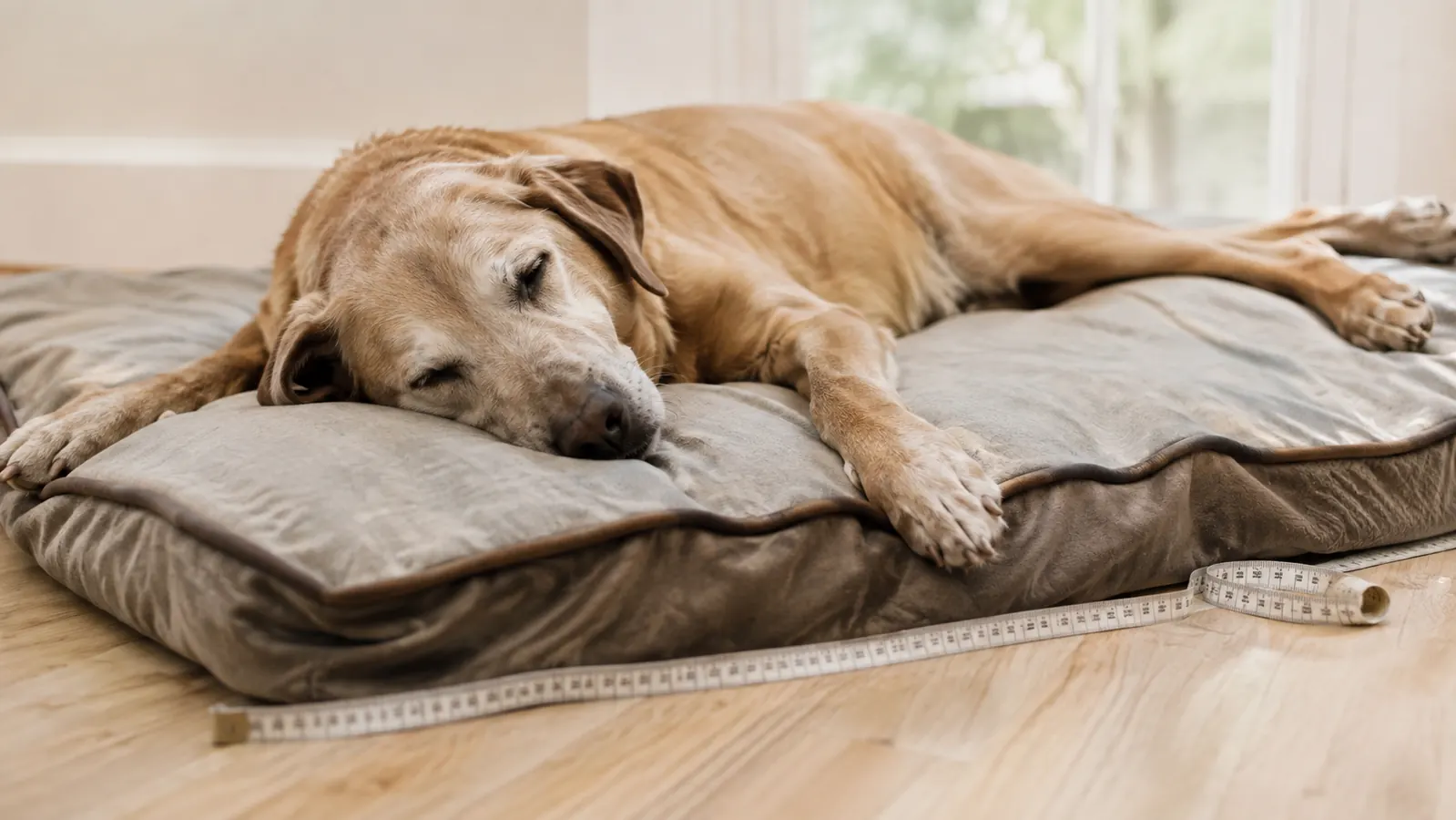
Measure the sleeping dog, not the standing one. A senior dog tends to stretch out on its side, and that is the longest position it will take. If your dog will not hold still for a tape measure, wait until they nap, lay the tape along the floor beside them, and read the length from nose tip to the base of the tail. Add a couple of inches for good measure and write the number down. You will compare it against every listing you open, and you will thank yourself for having it.
Weigh your dog too, because the weight range protects the foam. Foam that is too soft for a heavy dog will bottom out to the floor within months, and foam that is too firm for a small dog will feel like a board. Match the bed to the heavier end of your dog's frame, and when you are torn between two sizes, go up. A bed that is too small is a waste of money, and a slightly oversized bed still supports the dog exactly the same way.
Step 2: Check the Foam, Not Just the Word Orthopedic
Here is where the tag lies. Orthopedic on a pet bed does not mean anything on its own. What matters is what is inside the cover. A bed that is only a thick slab of soft foam feels nice for a week and then compresses into a hammock with the dog's body in the middle, which is exactly the opposite of what a stiff hip needs.
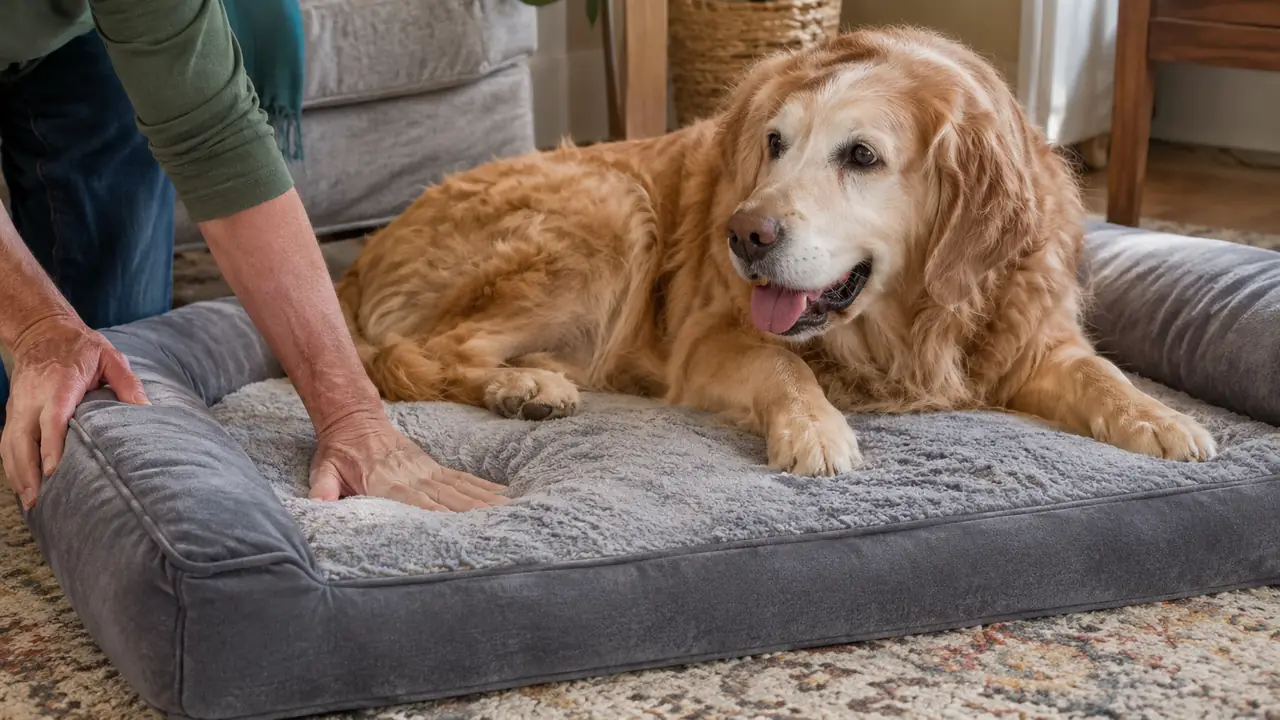
Look for a two-layer construction like the Furhaven: an egg-crate comfort layer on top of a solid orthopedic foam base. The egg-crate layer cradles the dog and lets air move, and the solid base underneath is what actually carries the weight and keeps the joints from pressing into the floor. That combination is the difference between a cushion and a support system. Press the bed with the flat of your hand and you want firm resistance, not a slow sink toward the ground.
Medium-firm is the sweet spot for a senior dog. You want enough support that the hip does not dip down and twist the spine, but enough give that a dog with stiff joints can settle in. A rock-hard bed is as useless as an all-fluff one. I would also skip beds that are only memory foam without a firmer base underneath. Memory foam alone molds around a heavy dog and can trap it in a sag, and a dog that already struggles to get up does not need to work harder to get out of a hole.
Step 3: Match the Shape to How Your Dog Sleeps
Beds come in a handful of shapes, and the right one depends on how your dog actually sleeps, not on which looks best in the listing photo. A flat rectangular mattress suits dogs that sprawl on their side with all four legs out. A round or donut bed suits dogs that curl into a ball. And a bolster bed or an L-shaped chaise, which is what the Furhaven Jumbo XL is, suits dogs that like to rest their head on something while the rest of the body lies stretched out.
Rocky is a leaner. For fifteen years he has flopped onto his side and propped his head on whatever was nearby, the arm of the sofa, a laundry pile, my leg. The L-shaped chaise has a raised side he can pillow his head on, and the long part gives his 78-pound body room to stretch. The first night he slept on it he put his head on the raised section and was out in minutes. That was the moment I knew I had picked the right shape.
Watch your dog sleep for a couple of nights before you buy. If they always curl into a ball, a bolster or bowl bed will make them feel held and secure. If they always flop flat on their side, a flat mattress or a chaise gives them the most room. A dog that has sprawled its whole life will not thank you for a round bed that is four inches too short in every direction.
Step 4: Get a Cover You Can Actually Wash
An older dog is a shedding, drooling, occasionally leaking machine. Rocky has been the hairiest thing in this house for a decade, his muzzle drools when he sleeps, and he has had exactly one accident on the bed since we brought it home. A removable, machine-washable cover is not a luxury on a senior dog bed. It is the whole ballgame, because the day will come when that bed needs a wash, and you need to be able to get it done without a fight.
Check the zipper before you buy. A cover is only removable if the zipper runs far enough to actually get the foam out, and some budget beds have a small opening that turns the removable cover into a two-person wrestling match. The Furhaven cover unzips cleanly and goes in the machine on a gentle cycle while the foam core stays out. You are not hauling a mattress to the laundromat.
Feel the fabric while you are at it. You want something that survives repeated washes and claws, with a little nap to it so the dog actually wants to lie on it. And if your dog is not fully reliable indoors anymore, look for a bed with a waterproof liner under the cover. A foam core that has soaked through once will hold odor forever, no matter how many times you wash the cover around it.
Step 5: Think About the Floor and the Getting In and Out
Where the bed lives matters as much as the bed itself. Rocky's hips stiffen in the cold, so I kept his bed off the tile in the mudroom and put it in the living room on the warm side of the house, out of the draft from the back door. A bed sitting on a cold, hard floor loses a lot of its warmth, and a senior dog with stiff joints wants warmth. If your only spot is tile or a bare basement floor, put a rug or a foam mat underneath.
Think about the entry, too. A bed with high sides can be hard for a dog that can no longer jump up easily. Rocky can still step onto the low profile of the Jumbo XL without help, but if your dog has back trouble or is losing strength in its hind legs, look for a bed that is lower to the ground or shaped so the dog can step in without lifting its back end much. You do not want a bed that is comfortable once the dog is in it but that the dog stops using because getting in hurts.
Put the bed near where you spend your evenings. Older dogs want to be close to their people even when they do not have the energy to follow you from room to room. Rocky's bed sits next to my armchair, and he settles there while I read. A bed tucked away in a back room will get used a lot less, which means the money you spent does less work.
What Else Helps
The right bed does a lot, but it is not a cure for arthritis, and it works best alongside a few other habits. Ask your vet about joint supplements if you have not already. Rocky has been on one for two years, and the combination of the supplement and the better bed is what keeps him moving. The bed is one tool in the kit, not the whole kit.
Keep the bed warm. I put a soft throw blanket over the chaise section in the winter, and Rocky burrows under it the way he used to burrow under the sofa cushions. If your dog is stiff in the mornings, that extra warmth makes a real difference in how easily they get up.
Give the switch time. Some senior dogs are set in their ways and will keep lying on their old spot on the floor out of habit for a week or two. I put Rocky's old cushion next to the new bed at first, and within a few nights he had abandoned it for the chaise on his own. A little patience beats dragging a stubborn dog onto a new bed and expecting them to stay.
Keep an eye on how the foam holds up. A good orthopedic base should feel about the same after a year as it did the first week. If you press the bed and your hand sinks to the floor, the foam is done, and no cover is going to fix it. That is the sign to replace the bed rather than keep living with a flattened one.
And know when a bed is not the answer. If your dog is in obvious pain, is struggling to stand, or has suddenly stopped using its bed entirely, that is a conversation for your vet, not a shopping trip. I am not a vet. I am just the person who bought his old dog a better place to sleep, and it helped. For anything more serious than that, talk to the professional.
Rocky is a 78-pound Labrador with hips the vet has been watching for two years, and for the first time in his life he settled into his bed in one try. He circled once, put his head on the raised edge, and was out. That was the moment I stopped second-guessing the whole purchase.
Give your old dog a bed that actually supports the joints
Start with the measurements in this guide, then look at the Furhaven Jumbo XL. It is the bed that ended Rocky's nightly restlessness, and it has held up to six months of daily use without sagging.
Amazon See Today's Price on Amazon →