
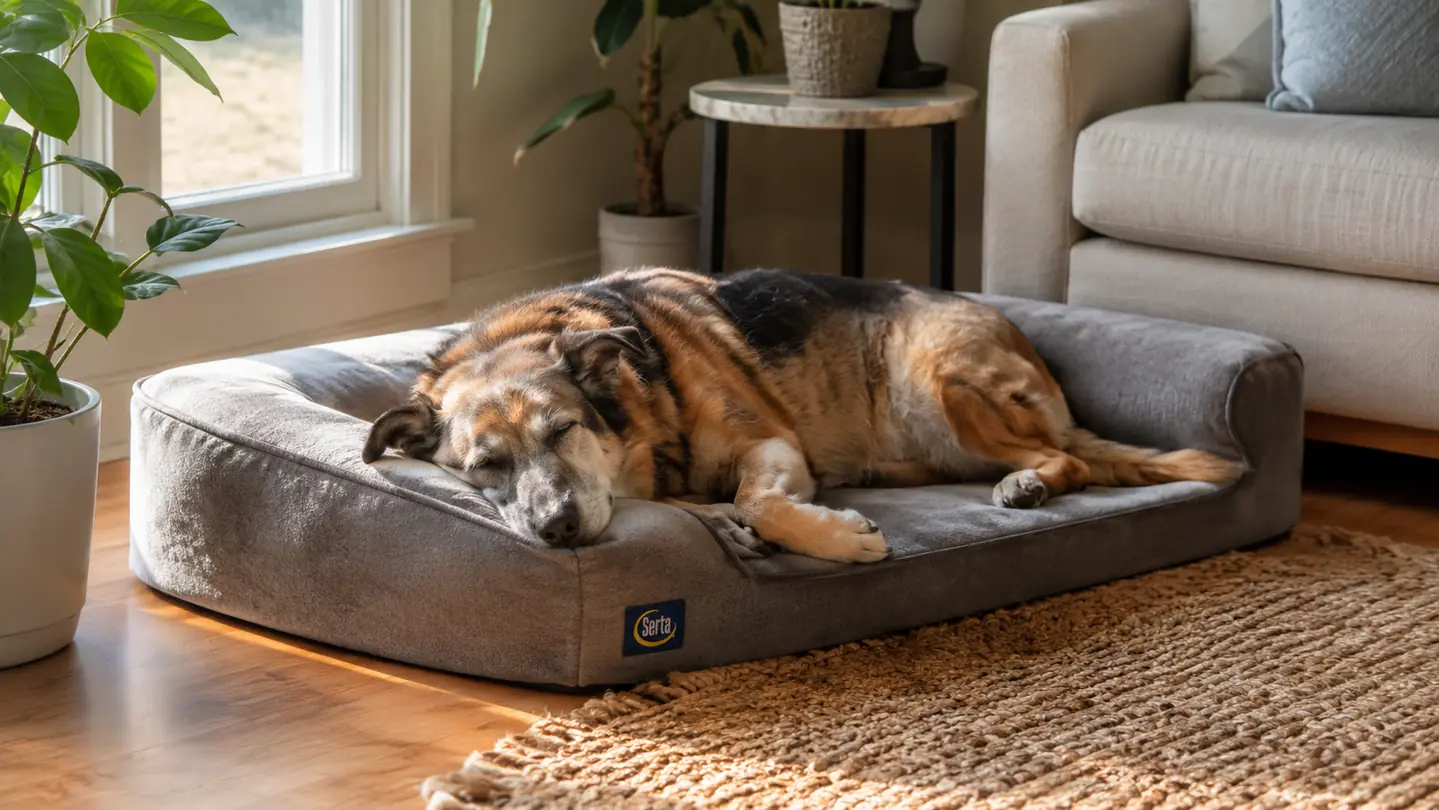
Gus is my 68-pound Lab mix, and at eleven years old his hips make the mornings slow. He rocks forward before he pushes himself up, hesitates before he hops off the couch, and sleeps in longer stretches so he does not have to move more than he has to. For years he slept on a flat cushion bed in the corner of the living room, the kind you grab at any big-box store, thin fill and no real structure. I never thought twice about it, until you watch a stiff dog sink into a cushion all night and come out of it stiffer in the morning.
The short version is that the difference shows up fast, and it shows up in the morning. For a big dog with achy joints, a bed with a solid orthopedic foam base is worth the extra money, and the Furhaven Jumbo XL is one of the most affordable versions of that idea. For a young, healthy dog that sprawls on the floor by choice, a flat bed is fine and cheaper. I put both kinds through daily use for six months with two very different dogs, so here is what actually changed and who should buy which.
| Furhaven Orthopedic Bed | Flat Cushion Bed | |
|---|---|---|
| Price | More upfront than a flat cushion, but reasonable for an orthopedic bed | Usually cheaper, sometimes by a lot |
| Joint support | Solid orthopedic foam base keeps hips and elbows off the floor | Thin fill lets a heavy dog sink through to the floor |
| Foam quality | Solid foam base that holds its shape under a big dog | Poly-fill or thin foam that flattens over months |
| Washability | Removable, zippered, machine-washable cover | Many flat beds have no removable cover at all |
| Durability | Sturdy base and cover hold up to daily use | A heavy dog packs the fill down and it does not spring back |
| Weight and portability | Heavier and bulkier; it lives in one spot | Light, easy to move room to room or toss in the car |
| Unboxing and setup | Arrives rolled and compressed; takes a day to puff back up | Ready to use the moment it comes out of the bag |
| Best for | Senior dogs, large breeds, dogs with stiff joints | Young dogs, dogs that prefer the floor, tight budgets |
How I Compared Them
Gus has used the Furhaven Jumbo XL every single night for about six months. Before that he slept on a flat foam cushion bed I replaced every year because the middle packed down until his hip bones touched the floor. Our other dog, June, is a two-year-old mutt who treats every bed as optional furniture, and she gave me a useful control case, because she is exactly the kind of healthy young dog that does not need orthopedic support. Gus gravitates to the orthopedic bed and sleeps through the night on it. June ignores both beds and sleeps on the cool tiles, which tells you the support only matters when a dog actually needs it.
I judged the two beds on five things: how much joint support they actually gave, how the fill held up under a heavy dog over months, how easy they were to keep clean, how much they cost, and whether they were a pain to live with in a normal house. I also watched for the small stuff that only shows up with daily use, like whether the cover stayed put, whether the base sagged, and whether either bed picked up a smell. The table above is the honest scorecard, and the sections below walk through where each kind of bed genuinely wins.
I am not a vet, and I did not run any controlled tests. I am a pet owner who watched two dogs use two kinds of beds every day for six months and wrote down what I saw. If your dog has a real joint condition, talk to your vet before you buy anything. This is about which bed holds up and which one helps a stiff dog rest easier, not about replacing medical care.
Where Furhaven Wins
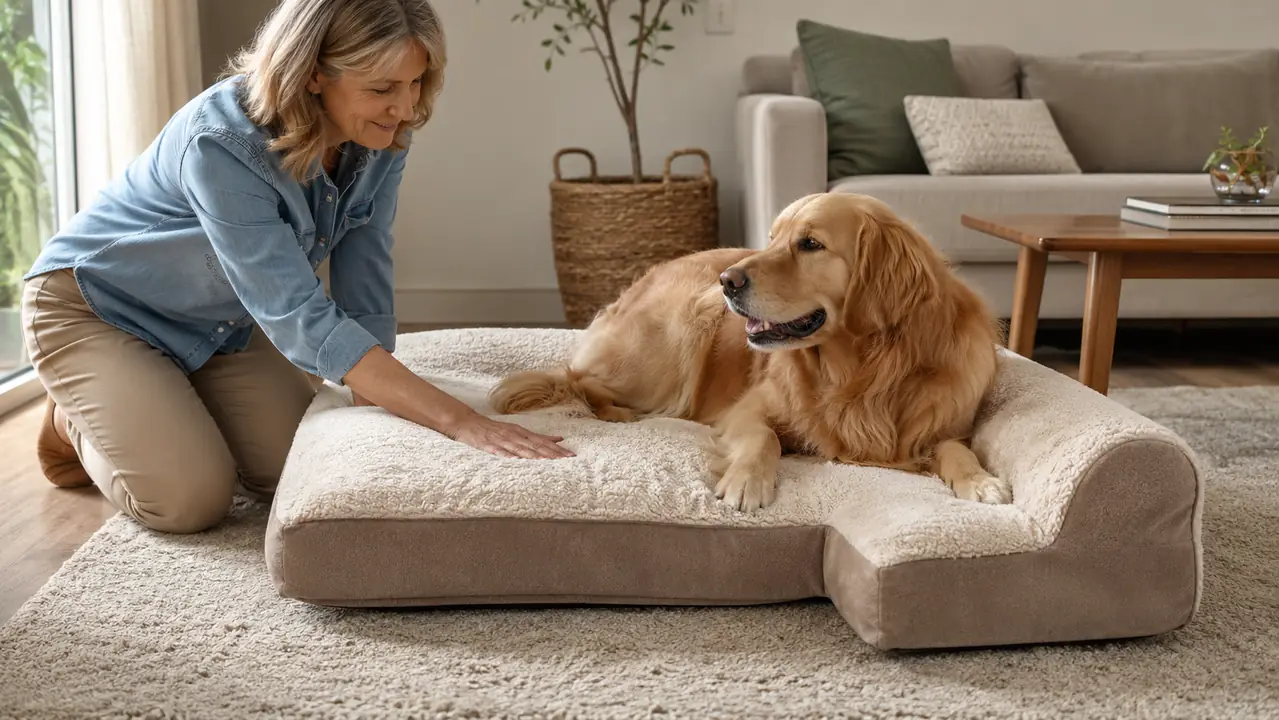
The biggest difference is underneath the surface, and it is the whole reason to pay more. The Furhaven has a solid orthopedic foam base with an egg-crate topper on top. When Gus climbs on, he rests on the foam instead of sinking through it, so his hips and elbows are supported rather than pressed into the floor. A flat bed has nothing solid under the cushion, so a heavy dog presses right through the fill and down to the floor. You can feel the difference with your hand: push on the Furhaven and it pushes back, push on a flat bed and it goes straight down.
The other thing that surprised me is the cover. It zips off, goes into the washing machine, and goes back on without a fight. Every flat bed I have owned ended up flattened or too musty to keep, because you cannot get a flat slab of foam clean once a dog has lived on it. Six months in, the Furhaven cover still washes up clean and the base holds its shape. For a bed a 68-pound dog climbs on a dozen times a day, that combination of support and washability is why it is still in the corner instead of the trash.
One more detail that matters more than it sounds like it should: the raised edge of the L-shaped chaise. Gus curls against it the way a person curls against a headboard, and he rests his head on it when he is half awake. A flat bed has no edge, so a big dog's head rolls off onto the floor, and his neck ends up at a weird angle. That edge turned out to be one of the things he actually uses, every single night, and it is part of why he chooses this bed over the bare floor.
Where a Flat Bed Wins
I am not going to pretend the flat bed has nothing going for it, because that is how you end up with a one-sided review that does not match real life. It costs less, sometimes a lot less, and it is light. You can move it from the living room to the bedroom, toss it in the car for a weekend trip, or buy two of them for what one orthopedic bed costs. If money is tight and your dog is young and healthy, a flat bed is a perfectly reasonable choice, and I would not talk you out of it.
A flat bed is also the right answer for a dog that simply does not need the support. June sleeps on the tiles over any bed I buy her, so paying extra for orthopedic foam for her would be solving a problem she does not have. The support only matters when the dog actually needs it, and spending before the dog is asking for it is how you end up with an expensive bed that gets ignored. Give the flat bed to the young dog and save the orthopedic bed for the one who needs it.
There is one more place a flat bed wins that is easy to miss: the first night. The Furhaven arrives rolled up tight and vacuum-packed, so it needs a day or two to puff back up to full shape. A flat bed comes out of the bag ready to use. If you are buying a bed the same day your dog needs it, the flat bed has you covered immediately while the orthopedic bed takes its time.
If your dog hesitates before getting up, this is the bed to try
The Furhaven Jumbo XL gives a big dog a solid base under the joints instead of letting them sink to the floor, and the zippered cover goes in the washing machine. It is the bed Gus has used every night for six months, and it is the one I would buy again.
Amazon Check Today's Price on Amazon →What Six Months of Daily Use Changed
The first change was not dramatic, and that is worth saying, because nobody should expect a bed to fix a dog's hips. Gus stopped circling as long before he lay down. On the flat bed he would walk in circles, paw at the cushion, and sigh, like he was trying to make the surface behave. On the Furhaven he does one small turn and settles. The second change showed up in the mornings. He used to rock forward two or three times before he could push himself up, and the first steps were stiff. He still gets up like an old dog, but he does not hesitate the way he did.
The bed itself also held up better than I expected. The base has not flattened in the middle the way his old cushion did, and the cover has not pilled or torn even though Gus climbs on and off it a dozen times a day. The seams are still tight, and the zipper still works. I have washed the cover every few weeks since June, and it comes out looking like it did the day it arrived. That is more than I can say for any flat bed I have owned, and it is the reason the price stopped bothering me.
One thing I will warn you about is size. The Jumbo XL fits Gus with room to spare, and he still chooses to curl against the raised edge like it is a pillow. If your dog is anywhere near 68 pounds, the smaller sizes will feel too small fast, and a bed that is too small is a bed a big dog will avoid. Measure your dog from nose to tail before you order, add a few inches, and when in doubt, go up a size.

What to Look for in an Orthopedic Bed
If you decide your dog is ready for an orthopedic bed, the phrase to look for is a solid orthopedic foam base. Some beds claim to be orthopedic and are really just a thick egg-crate topper sitting on a soft base, which feels plush for a week and then collapses under a heavy dog. The egg-crate layer is comfortable, but the solid base underneath is what actually supports the joints, and that is the difference between a bed that helps a stiff dog and a bed that just looks like it should. The Furhaven has the solid base, which is one of the reasons I picked it.
Check the cover before you buy. A removable, machine-washable cover is worth a lot on a bed a dog will live on, because a bed you cannot wash is a bed you will replace. Look at the seams and the zipper too, because those are the first things to fail on a bed that gets daily use. And think about the shape. An L-shaped chaise with a raised edge gives a dog a place to rest their head and a spot to curl into. A flat rectangle works for a dog that sprawls, but most older dogs want that edge.
He does one small turn and settles now. On the flat bed he circled and pawed and sighed like he was trying to make the surface behave.
The Cost Question
The honest math is not as one-sided as you might think. A flat bed is cheaper on day one, but if a 68-pound dog flattens it in a year, you are buying another one, and then another. The Furhaven has held its shape for six months, and the cover washes, so it is still doing its job at an age when most flat beds are already done. If the flat bed lasts one year and the orthopedic bed lasts three, the per-year cost is close, and the orthopedic bed does a better job the whole time.
None of that matters if your dog is young and healthy. For June, a flat bed is the smarter buy, because she does not need the support and she does not wear the fill down the way Gus does. The cost math only flips in favor of the orthopedic bed when the dog actually needs the support, because that is when the extra durability pays for itself. Buy for the dog you have right now. If your dog is not stiff yet, save the money, and you can always upgrade the day the dog starts asking for it.
Who Should Buy Which
Buy the Furhaven orthopedic bed if you have a senior dog, a large breed, or any dog that is stiff getting up, hesitates before stairs, or has been told by the vet to watch their joints. Buy it if you are tired of a bed that flattens out and cannot be washed. It costs more up front, but it is built to take a heavy dog's weight for years, and you can actually keep it clean. That is the trade I made, and six months in I would make it again.
Buy a flat bed if your dog is young and healthy, if your dog prefers the floor anyway, or if the bed has to travel. A flat bed is a fine place for a dog to nap when the dog does not need the support. Just know what you are getting: a comfortable cushion, not joint support. If the dog is not stiff, do not spend the extra money yet. You can always upgrade later, when the dog actually needs it. A used flat bed beats an ignored orthopedic bed every time.
Give your dog a bed that holds them up
The Furhaven Jumbo XL has supported Gus through six months of daily naps, and the cover still comes off and washes clean. If your dog is slowing down, it is the upgrade most likely to make a difference you can see in the mornings.
Amazon Check Today's Price on Amazon →