
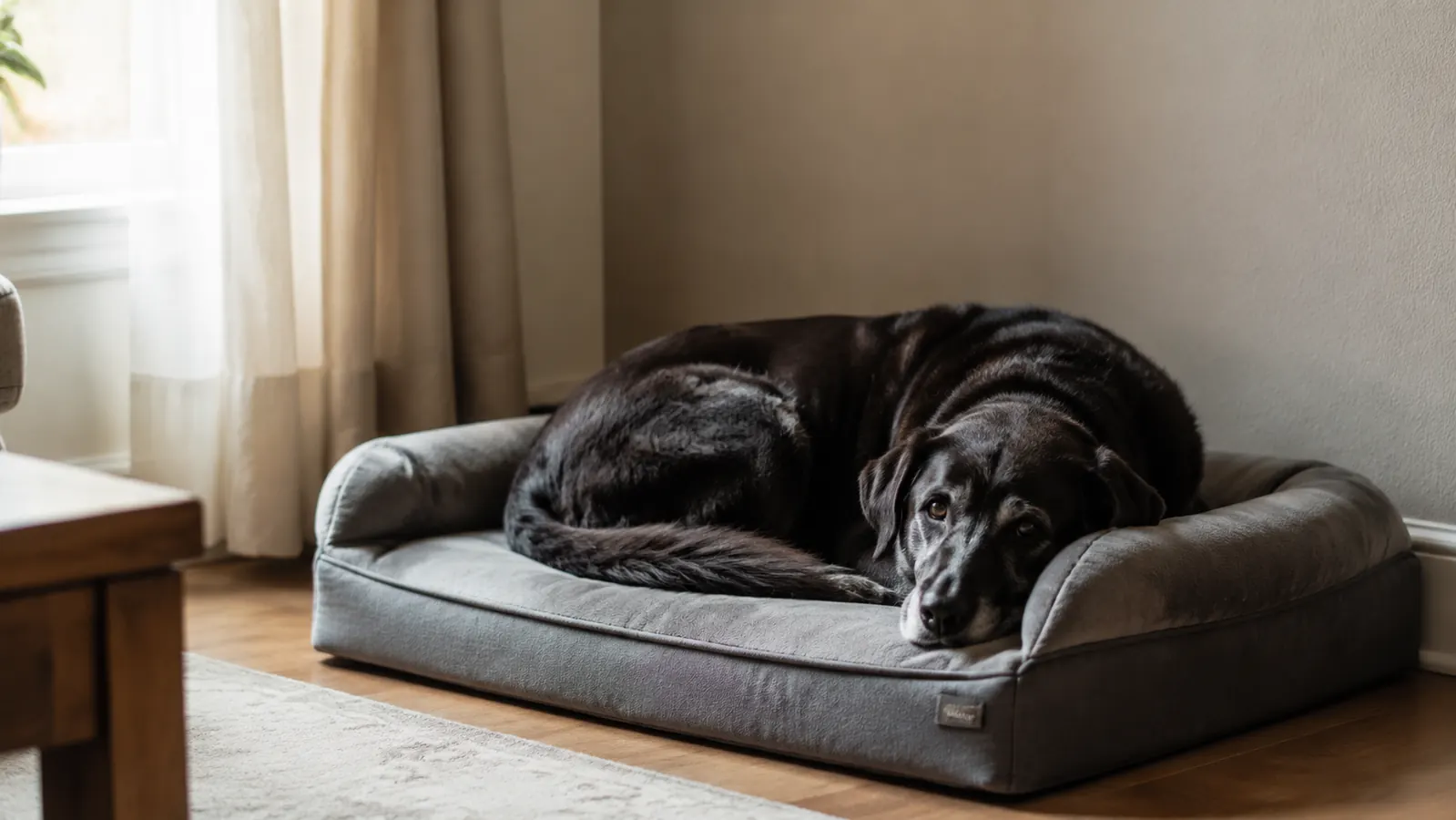
Every night for about a year, my 12-year-old Lab mix Maggie did the same thing. She would circle her flat cushion bed three times, sigh, flop down, and then twenty minutes later get up and lie on the bare floor. She is 74 pounds with mild hip arthritis that our vet diagnosed in 2024, and the thin mat in the living room simply was not carrying her weight anymore. I tried a memory foam topper first, then a cheap egg crate pad, and both flattened out within a couple of months. I was tired of spending money on beds that went flat and that she refused to use.
Last January I finally ordered the FurHaven Orthopedic Dog Bed in Jumbo XL, the L-shaped chaise with the solid foam base and the removable washable cover. Six months later it is still the first place she heads after breakfast and the only bed in the house she sleeps on all night. She used to sigh and shift positions all night, and I would find her on the floor by morning more nights than not. That stopped within the first two weeks. This is the long version of those six months, including what I like, what I would change, and whether it is worth the money for a dog who is slowing down.
The Quick Verdict
Six months in, the FurHaven is the first dog bed that has held its shape, survived the wash, and given my arthritic senior dog a full night of sleep. It is not a firm medical mattress, so very heavy dogs may want a firmer option, but for a 74-pound dog with early arthritis it is the bed I would buy again.
Amazon Check Today's Price →The Bed Maggie Actually Sleeps On
After six months of daily naps and overnights, the FurHaven Jumbo XL is still the first bed she picks. Check today's price and the full size range before you order.
Amazon Check Today's Price on Amazon →How I've Used It
Maggie has slept on this bed every single day since the middle of January. She takes a two-hour nap in it most mornings, another in the afternoon, and she sleeps there overnight. That is easily eight to ten hours of weight on it daily, which is the real test for any dog bed, because steady weight is exactly what kills cheap foam.
For context, she is 74 pounds, and our vet put her on a joint supplement after diagnosing mild arthritis in her hips in 2024. She is not severely disabled, but she gets stiff getting up on cold mornings, and the flat bed she had before let her sink straight to the floor. I have washed the FurHaven cover every three to four weeks since we got it, on a gentle cycle with cold water, and I air dry it.
So this is a long-term report, not a first-impressions one. I know how this bed looks after a week, after a month, and after six months of a senior dog sleeping on it every night, and I have a good idea now of what holds up and what does not.
What Makes the FurHaven Different from the Cheap Beds
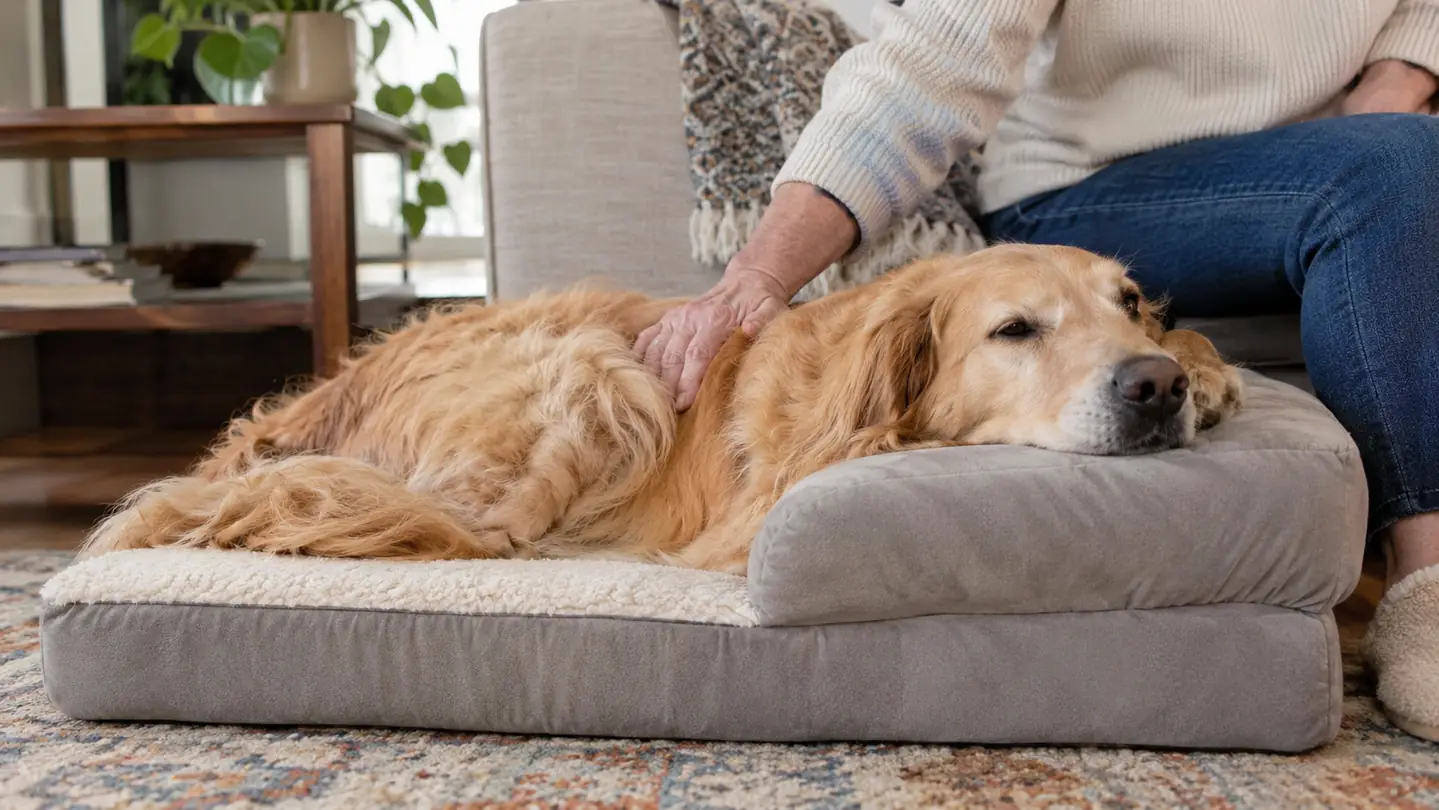
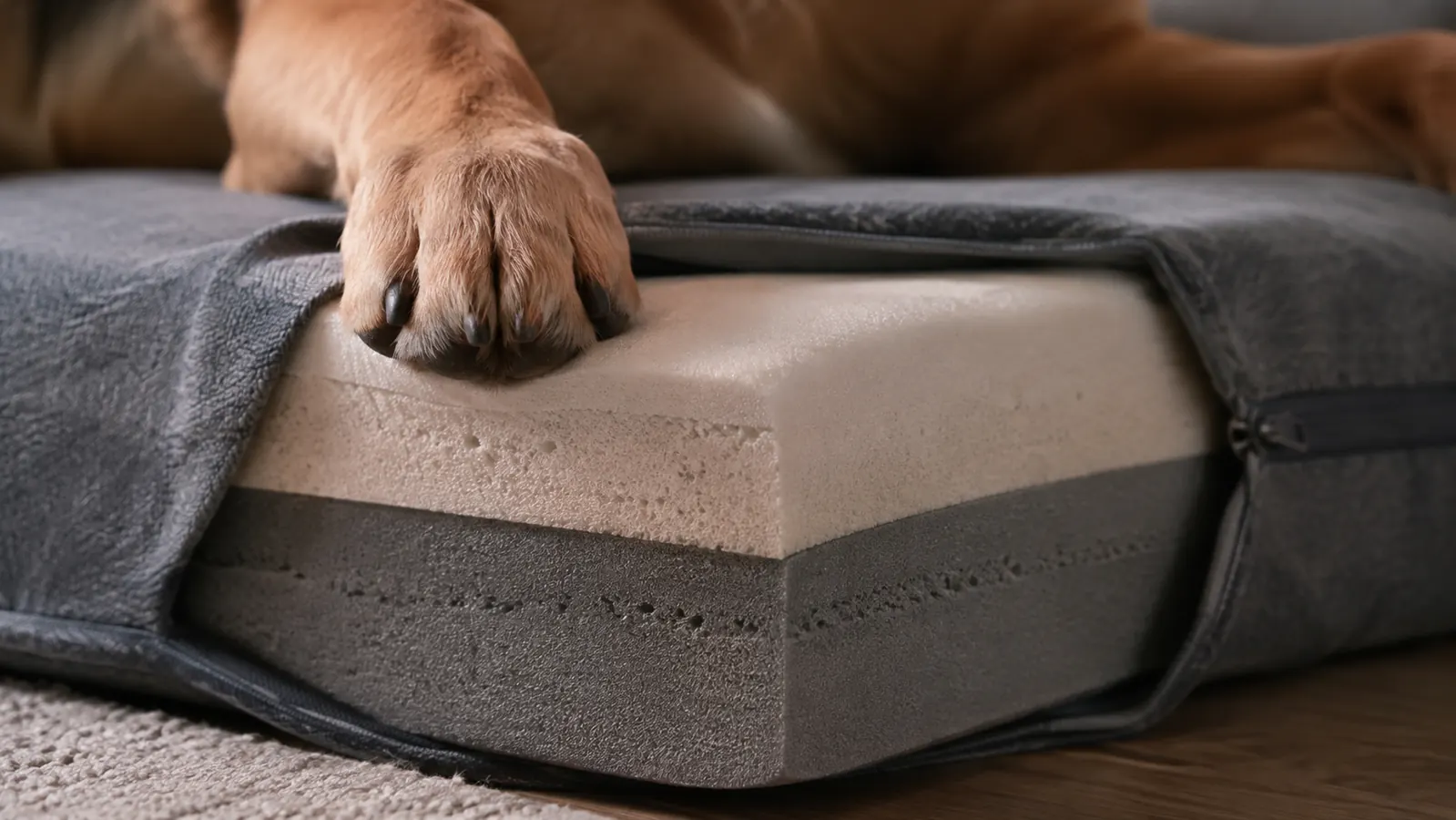
The part that matters is what is inside. The FurHaven has a solid orthopedic foam base with a softer egg crate layer on top, so your dog does not sink through to the floor the way they do on a fiber-filled cushion. When Maggie lies on it, her hips and shoulders stay supported instead of pressing flat against the floor. That is the difference between a bed that holds a joint up and a bed that just looks fluffy. When I first unpacked it, I thought the top felt softer than I expected for something called orthopedic, but the solid base underneath is what does the work. Both layers have to be there, and after six months I understand why.
The other thing that sold me is the shape. It is an L-shaped chaise, which means there is a raised bolster along the back and one side, and a flat open area in front. Maggie rests her head on the bolster when she sleeps and sprawls across the open section when she is warm. Dogs like having something to lean against, and the shape gives her that tucked-in feeling without enclosing her.
The cover is a plush, velvet-like fabric, and it unzips completely so you can wash it. I was worried velvet would be a fur magnet, and it is, but it is also soft enough that she settles onto it right away. And because the cover comes off and goes back on without a fight, I actually wash it, which is more than I can say for her last two beds.
Unboxing and the First Two Weeks: Getting a Picky Dog to Use It
The FurHaven ships compressed, so the foam needs time to expand before you judge it. When I opened the box, the bed came folded into a tight roll and the foam base looked about half its final thickness. I laid it out in the living room in the exact spot where her old bed used to sit and let it sit for the rest of the day. It was mostly puffed back up by mid-afternoon and fully back to shape by the next morning. If you order one, give the foam a full 24 hours to breathe before you decide whether it feels firm enough, because the first few hours are not a fair test.
The bigger surprise was how long it took Maggie to trust the new bed. She sniffed it, walked around it, and then lay on the floor next to it the first night. I did not push her. I folded one of her old blankets onto the bolster so it smelled like her, and I left the bed where the old one had been. By day three she was napping on it, and by the end of the first week she was sleeping there all night. If you are worried your dog will ignore a new bed, that is the trick that worked for us: same spot, familiar blanket, and no pressure.
Six Months of Daily Naps: How the Support Has Held Up
The honest headline is that the foam has not flattened. After six months, when I press on the sleeping surface, it springs back. The egg crate layer has a little more give than it did on day one, but the solid base underneath still holds, and Maggie no longer ends up lying on the floor in the middle of the night. That was the pattern with her old bed, and it stopped in the first week with this one.
The change in her routine is what convinced me. Around week two she stopped circling before she lay down. She walks onto the bed, turns around once, and drops. In the morning she gets up a little less stiffly than she did on the flat bed. I do not want to oversell it. She is an old dog with arthritis, and no bed is a cure. But she is sleeping through the night more often, and she is choosing the bed over the floor and the couch, which she never did before. She still has good days and bad days, and on the bad ones she camps out on this bed all afternoon instead of following me around. That alone tells me it is doing something right.
One thing I did not expect was how she nests on it. Maggie scratches at the surface for a few seconds before she settles, the way dogs do before they lie down, and after six months that scratching has not torn or snagged the cover. On her worst days, when the cold got deep into her hips, she barely moved off the bed from morning until dinner. Those are the days I am most grateful for the solid base, because a flattened cushion would have left her on the floor by mid-afternoon.
The one thing I will flag is that this is not a rock-hard medical mattress. The egg crate layer makes the top fairly soft, and a very heavy dog, or one with serious mobility trouble, might want the firmer solid-foam version or a bigger size. For Maggie at 74 pounds, the Jumbo XL has enough depth that she does not bottom out.
Six months in, Maggie still walks onto this bed, turns around once, and drops. That is the whole review, really.
Washing the Cover: The Part That Actually Wears Out
Dog beds get gross, and the cover is where a bed proves itself. The FurHaven cover is removable, which sounds basic, but plenty of beds in this price range are not, or their zippers give up after a few washes. Ours has been through at least six wash cycles, and the zipper still works, the seams still hold, and the fabric has not pilled into fuzz. The zipper is tucked along the bottom seam, so it does not poke her when she lies on it, a small detail I did not expect to care about but I do.
I wash it on a gentle cycle with cold water and let it air dry, and it takes me about an hour to wrestle it back on. It is a two-person job on the Jumbo XL, because the foam base is big and the cover fits snugly. But that snug fit is exactly why the cover does not wrinkle and slide around when she moves.
The honest con is that the velvet cover collects fur like you would expect, and it shows dust. I brush it with a lint roller between washes. It is not a dealbreaker, but if you want a bed that looks spotless with zero effort, this is not that bed.
What I Wish I Knew Before Buying
Size matters more than I expected. I ordered Jumbo XL because she is a big dog, and it takes up a real corner of the living room. Measure the spot before you order, because this bed is generous. On the other hand, a bed that is too small is worse than no bed for an arthritic dog, so when in doubt, size up.
The bed does not have a non-slip backing that grips the floor in every direction. On a hard floor it slides a little when she jumps off, and we solved that with a rug underneath. It is worth knowing before you put it on bare tile or hardwood.
And it is not a crate mat. If your dog sleeps in a crate, this L-shaped bed is too bulky. FurHaven makes flatter beds for crates, and this one is meant for open floor space. It is also not the bed for a dog who chews, because the cover is soft fabric and a determined chewer will get through it.
How It Compares to the Alternatives We Tried
For the sake of comparison, Maggie has slept on three kinds of beds in the past two years. The first was a fiber-filled cushion, which went flat in about three months and left her on the floor. The second was a memory foam mat, which was firmer but had no raised edge, so she never got comfortable and kept sliding off. The FurHaven is the first one that combines real foam support with a shape she actually wants to sleep in.
I also looked at the firmer solid-foam orthopedic beds, and I came close to buying one. The reason I did not is that Maggie is not heavy enough to need that level of firmness, and the softer egg crate top gets her to actually settle. If your dog is 90 pounds or more, or has advanced joint disease, the firmer option is worth the upgrade, and FurHaven makes those too.
The math is simple for us. We bought two beds in the two years before this one, and both ended up flat or ignored. The FurHaven has outlasted both of them combined, and it is the one she picks every single day. For something a 74-pound dog sleeps on for eight hours a night, that kind of durability is what makes the price reasonable in the end.
The flat beds FurHaven sells, and the crate mats, are fine for what they are, but they do not have the bolster. And the bolster is the part Maggie leans on every night. If I were buying again for her, I would make the same choice.
What I Liked
- Solid foam base still holds its shape after six months of daily use
- Raised bolster gives a senior dog something to lean on and feel secure
- Removable cover unzips, washes well, and goes back on without a fight
- Jumbo XL has enough depth that a 74-pound dog does not bottom out
- The dog actually uses it, which was not true of her last two beds
Where It Falls Short
- Velvet cover collects fur and needs brushing between washes
- Slides a little on hard floors without a rug underneath
- Top layer is soft, not a firm medical mattress for very heavy dogs
- Jumbo XL takes up a real corner of the room
Who This Is For
Buy this bed if you have a middle-aged or senior dog who is starting to slow down, who circles before lying down, or who abandons their bed for the floor. It is also a good pick for a normal-weight adult dog who just wants a comfortable place to sprawl, because the soft top and the raised bolster are comfortable, not just therapeutic. And if your dog already sleeps on a flat bed and you want better support without jumping to the most expensive orthopedic option on the market, this is a sensible middle step. It is not the cheapest bed you can buy, and it is not the most expensive, but it sits in the sweet spot where the foam is real and the cover is washable.
Who Should Skip It
Skip it if your dog chews beds, if you need a flat crate mat, or if you have a very heavy dog with serious mobility problems who needs a firmer, medical-grade foam. And if you hate vacuuming fur, the plush cover will test your patience. For those cases a flatter, firmer, or more chew-resistant bed is the better buy, and it will save you the aggravation.
Six Months Later, I Would Buy It Again
Maggie sleeps on it every night, the foam has held its shape, and the cover still washes clean. If you are weighing an orthopedic bed for an older dog, this is the one to start with.
Amazon Check Today's Price on Amazon →