
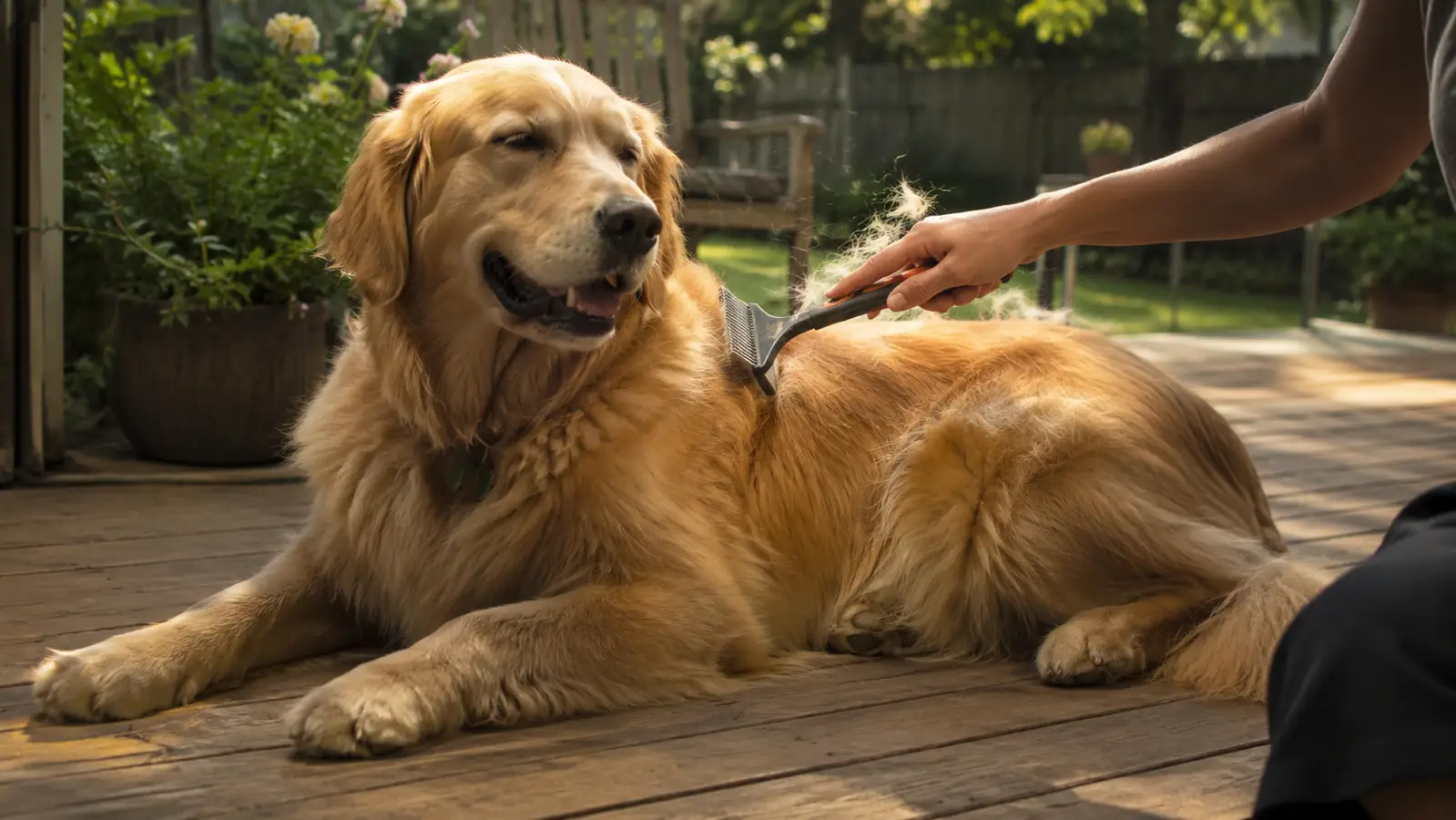
I bought the FURminator first, back in March, because my Golden Retriever Baxter was shedding so hard that I was vacuuming twice a day and still finding fur in my coffee. My sister grooms dogs on the side, and when she saw me complaining, she handed me her undercoat rake and said, 'try this before you buy anything else.' Six months later I have used both tools on the same dog through the same shed, and the honest answer is that neither wins outright. They do different jobs, and which one belongs in your grooming drawer depends on your dog's coat and your patience.
If you have a double-coated dog, a Golden, a Husky, or a German Shepherd, and you want to knock down a serious seasonal shed in the fewest sessions, the FURminator is the stronger tool. Its stainless edge reaches deep into the loose undercoat and pulls it out in dense strips, and the ejector button clears the blade in one motion. But it costs more, and it punishes a heavy hand. A plain undercoat rake costs a fraction as much, feels gentler on a dog that fidgets, and is easier to use every day, but it takes longer to get the same result. Here is how the two compare after months of real use on one very sheddy dog.
How I Compared the Two Tools
Baxter is a nine-year-old Golden Retriever, about 72 pounds, with the kind of double coat that sheds year-round and then explodes in spring and fall. He is not a show dog and he is not a puppy, so he is also not especially patient about standing still for grooming. I started the comparison at the beginning of the spring shed in March and kept notes through the summer, brushing him outdoors on the porch twice a week with one tool and then the other so each got a fair turn on the same coat.
I used each tool the way its instructions recommend. With the FURminator I worked in the direction of the coat with a light touch and let the tool do the pulling, and I stopped the moment Baxter seemed annoyed. With the rake I used the same light pressure but a longer, slower stroke. I kept a rough count of how much fur came off each session and, more importantly, how many days passed before the furniture looked like a second dog lived on it. That is the number that actually mattered to me.
One note on the rake itself, since it is not a single product the way the FURminator is. Undercoat rakes range from a cheap plastic model at the pet store to heavier steel versions, and the differences matter more than the price. Look for rounded tips on the tines, because flat or sharp tips are what scratch a dog's skin, and choose a tine length that roughly matches the thickness of your dog's undercoat. A wider rake covers more ground faster, but a narrower one is easier to control on the legs and tail. I borrowed my sister's mid-price steel rake for the test, the kind with rounded tines that you can find for well under what the FURminator runs.
| FURminator | Undercoat Rake | |
|---|---|---|
| Price | Premium deshedding tool, costs more up front | Budget grooming tool, usually a fraction of the price |
| Loose undercoat removed per session | Stainless edge pulls a dense strip of undercoat in one sweep | Pulls plenty, but you will rake the same patch more times |
| Coat-type fit | Sold in short, medium, and long hair versions so the blade matches your dog | One rake fits most double coats, but you pick the tine length yourself |
| Comfort on a sensitive dog | Firm and precise, needs a light touch and a cooperative dog | Rounded tines feel gentler and forgive an unsteady hand |
| Cleanup between passes | Fur ejector button pops the whole strip off in one motion | You pull hair from the tines by hand or with a comb |
| Everyday touch-up brushing | Built for a few thorough sessions a week during heavy shed | Light enough for a quick daily pass without overdoing it |
| Heavy seasonal blowout | Clears out a full undercoat in a few sessions | Works, but expect more sessions to reach the same point |
| Best for | Owners fighting heavy shedding and fur on the furniture | Owners with a sensitive-skinned or grooming-shy dog |
Where the FURminator Wins
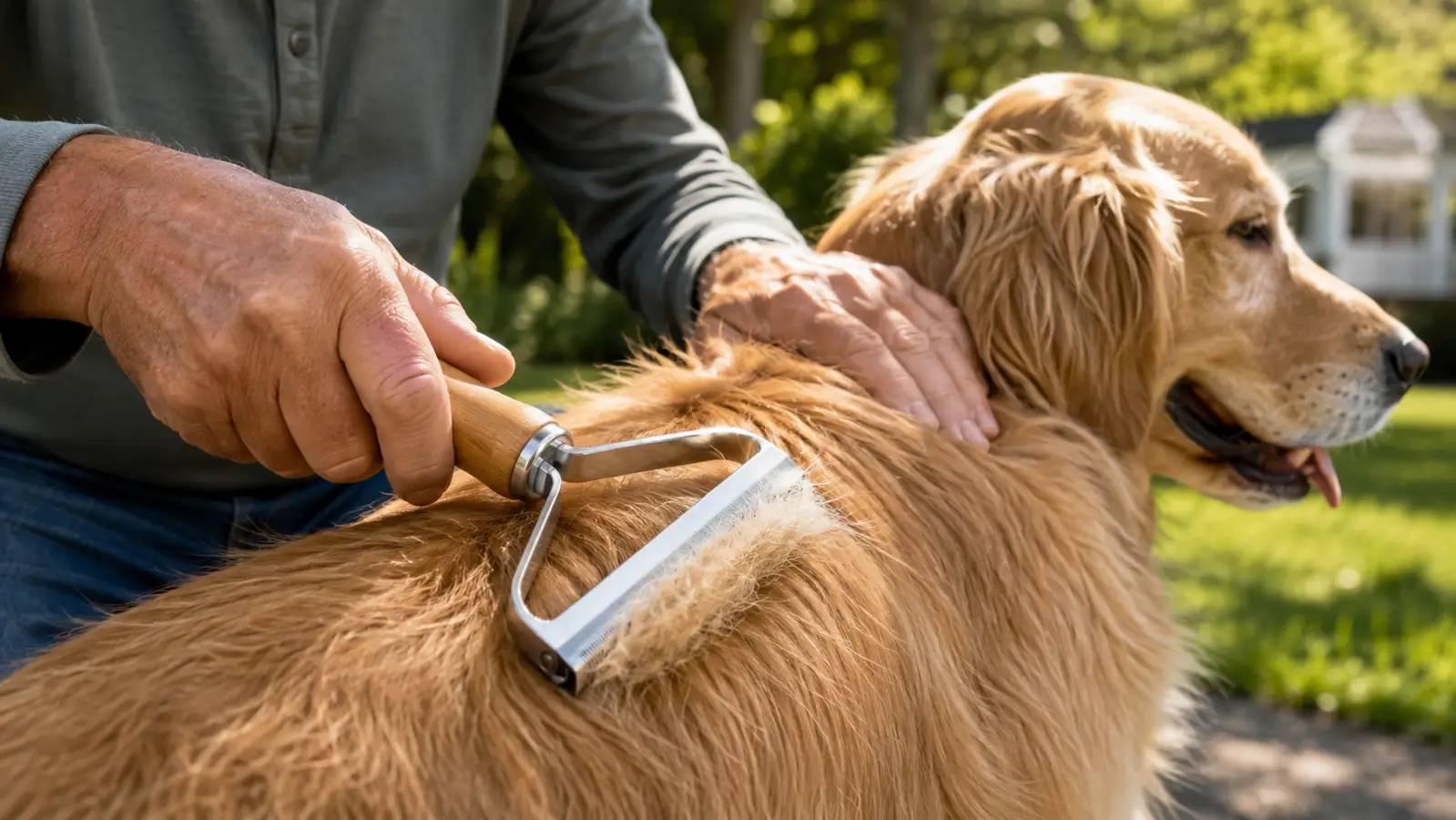
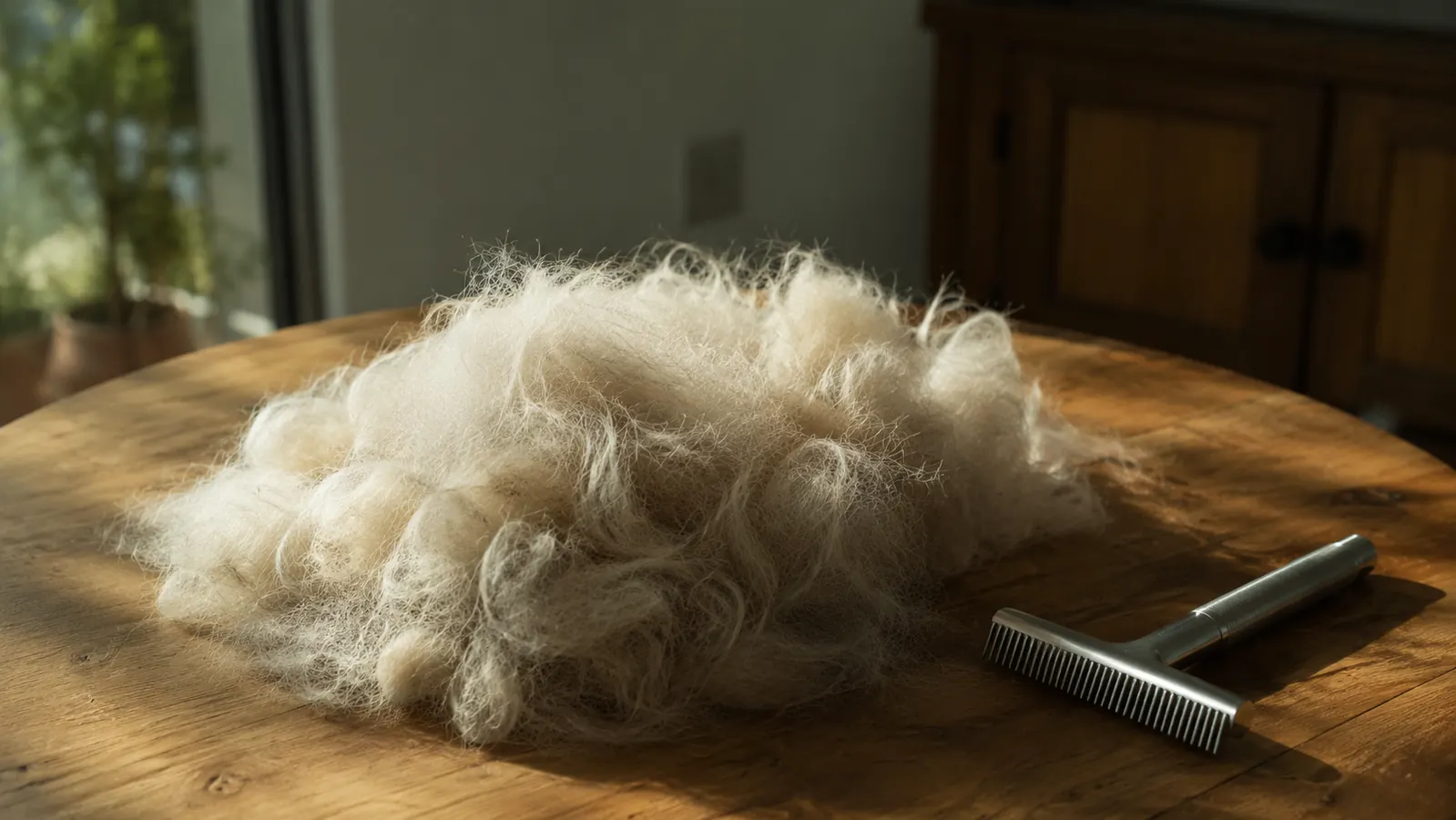
Baxter is a classic double-coated shedder, and during his spring and fall blowouts the FURminator is the tool that makes the biggest visible dent. The first time I used it, I worked over his back for maybe ten minutes and pulled out a strip of undercoat so dense that I had to stop and take a picture for my sister. The stainless edge reaches past the topcoat into the loose undercoat underneath, and the design pulls the fur out rather than just brushing the surface, which is what a lot of cheap brushes do. By the end of that first week, the amount of fur on the floor had dropped by more than half.
The fur ejector button is the detail that sold me on it. When the blade is full, you press the button and the whole strip slides off in one piece, straight into the trash bag. With the rake, you stop every few passes and pick hair out of the tines by hand or with a comb, and that adds up over a full grooming session. The FURminator also comes in short, medium, and long hair versions, so the blade depth matches your dog, and the stainless edge has held up through months of weekly use without bending or dulling. For the worst weeks of the shed, I reach for it every time.
I will also say the FURminator is the better choice when you are short on time. A full undercoat blowout that takes the rake three or four sessions to get through, the FURminator handles in two. If your dog sheds in heavy seasons and you would rather spend one thorough hour grooming than an hour a day with the vacuum, that difference matters. That is the difference between controlling the shed and letting it control you.
Where an Undercoat Rake Wins
Here is the part nobody tells you. The FURminator is a precise tool, and that precision cuts both ways. Baxter has sensitive skin around his belly and on the backs of his legs, and if I use the FURminator there with the same pressure I use on his back, he flinches and walks away. The undercoat rake, with its rounded steel tines, is far more forgiving. I can use it on the parts of him that the FURminator irritates, and he will stand there and let me work without complaint. For a dog that hates grooming, that gentleness is the whole ballgame.
The price difference is not small. A good undercoat rake costs a fraction of what the FURminator runs, so it is the lower-risk way to test whether your dog will even sit still for deshedding. If your dog has a moderate shed, is small, or will not hold still for the more aggressive tool, the rake is the smarter buy, and you will not feel you wasted money if your dog quits after ten minutes. It is also easier to use daily, lighter and less aggressive, and you do not have to watch your pressure the way you do with the FURminator.
The rake also wins on the legs, the tail, and the feathering, the places where the FURminator's deeper blade feels too strong. I keep the rake by the back door and use it for a two-minute pass most evenings. That daily maintenance is what keeps the shed from building up between the big sessions, and it is something I would never do with the FURminator because I would be afraid of over-grooming the same spot.
The FURminator wins the heavy shed. The rake wins the dog that hates being brushed. Most owners eventually end up with both.
The Coat-Type Question: Double Coats vs Single Coats
The reason so many owners argue about these two tools is that they are usually comparing dogs, not tools. A double-coated dog, think Golden, Husky, or German Shepherd, grows a soft, dense undercoat under a longer topcoat, and that undercoat is what ends up all over your furniture in the spring and fall. A single-coated dog, think Poodle or Boxer, has no such undercoat, so the deshedding conversation changes completely. If your dog is single-coated, you barely need either tool.
The FURminator is built for that double-coat undercoat. The stainless edge reaches through the topcoat and grabs the loose undercoat, which is why it pulls those dense strips of fur. But on a single coat there is not much undercoat to grab, and you can end up dragging a blade over a coat that does not need it. For a short-haired single-coated dog, a rubber curry brush or a grooming glove is honestly a better tool, and you save the money.
An undercoat rake is also a double-coat tool, but it is tuned for the other extreme. A Husky or a Samoyed in full winter coat has undercoat so thick and woolly that a FURminator blade feels like it is dragging through felt. The rake's longer tines slide deeper and pull the wool out in clumps without the same tug. The real question is not which brand is better, it is how thick and woolly your dog's undercoat actually is.
One Warning Before You Buy
The one warning I will give you applies to both tools: do not over-groom. The undercoat exists to insulate your dog, and pulling out more than the loose stuff can leave a double-coated dog with a thin, patchy coat and skin that gets irritated. With the FURminator especially, stop when the tool stops pulling fur, not when the coat looks thin. When I first started, I was so happy to see the fur coming out that I kept going too long, and Baxter's back got pink and sore. It healed in a few days, but I learned to watch the coat instead of the pile.
With the rake, over-grooming is less of a risk because it simply does not grab as much per pass, but you can still rub the skin raw if you go over the same spot again and again. If your dog starts to flinch or tries to walk away, that is the sign to stop, no matter which tool you hold. Grooming should be a few focused sessions a week, not a nightly excavation.
The tool that finally got the shed under control
If your dog sheds like Baxter, the FURminator long-hair model pulls out the loose undercoat in a few sessions instead of a few weeks. See today's price on Amazon.
Amazon Check Today's Price on Amazon →A Few Grooming Habits That Matter More Than the Tool
Whichever tool you pick, the technique matters more than the brand, and I learned most of it the hard way. Start with a coat that is clean and free of mats. Neither a FURminator nor a rake is a de-matting tool, and dragging either one through a tangle pulls the dog's skin and makes the session miserable. I keep a separate slicker brush for the trouble spots on Baxter's ears and tail before I ever pick up the deshedding tool.
Work in the direction the hair grows, in short sections, and let the tool do the work. With the FURminator, the mistake is pressing down. The edge should skim the coat, not dig into it, and a few light passes over one spot pull more fur than one heavy pass that makes the dog flinch. If the dog leans away or walks off, that is your cue to lighten up or stop, no matter how much fur is still on the floor.
Plan the big sessions around bath day. Grooming a double-coated dog before a bath loosens the dead undercoat, and grooming again once the coat is fully dry pulls out even more, because the warm water and drying help release the loose fur. It sounds like twice the work, but it cuts the total time, because the post-bath pass reaches fur the first pass could not. Clean the tool when you finish, and a clean tool grabs far more fur than a clogged one.
Who Should Buy Which
Buy the FURminator if you have a double-coated dog that sheds in serious seasons and you want fewer, more effective grooming sessions. It is the right choice for a Golden, a Husky, a German Shepherd, or any dog whose undercoat takes over the house in spring. You pay more up front, but the fur ejector, the coat-matched blades, and the faster blowout are worth it when the shed is at its worst.
Buy an undercoat rake if your dog has sensitive skin, if grooming is a battle, or if your budget is tight and you are not sure a premium tool is worth it. The rake is the better first tool for a first-time owner, because it is harder to do damage with it and it works on just about any coat. For a small dog or a light shedder, the rake is all you need, and you can spend the difference on treats your dog will actually enjoy.
The honest truth is that many owners end up with both, and I did too. I use the rake for quick daily touch-ups and for the sensitive spots, and I bring out the FURminator a few times a week during the heavy shed. If you can only afford one, match it to your dog's biggest problem. A heavy seasonal shed points to the FURminator. A dog that hates being brushed, or a tight budget, points to the rake. If you want the full picture, my long-term review covers six months of weekly use, and my honest review digs into the pressure mistakes and the coats it does not suit.
Start with the tool that matches your dog
For a double-coated heavy shedder, the FURminator is the one that makes the visible difference. Check today's price on Amazon and pick the model that fits your dog's coat length.
Amazon Check Today's Price on Amazon →