
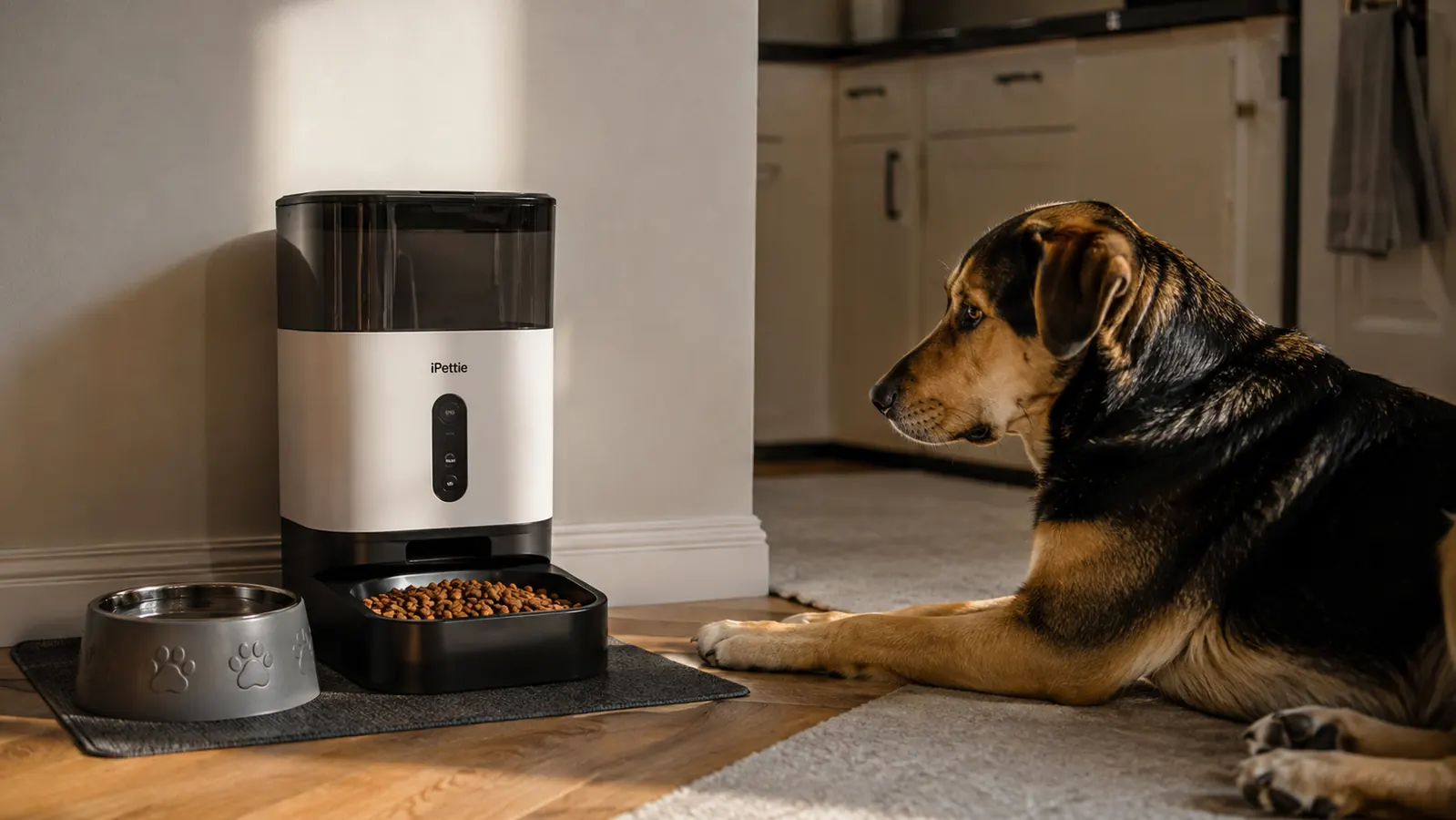
I'll be honest with you, I almost packed this feeder back in the box during the first week. Not because it stopped working. Because I set it up wrong, the kibble jammed on day three, and I found my 70-pound Lab mix Duke standing over the bowl with the kind of look that said he was filing a formal complaint. That first jam taught me more about how this feeder actually works than the manual ever did, which is exactly why I wanted to write this review the way I am.
Here's what nobody tells you about the PetSafe automatic dog feeder. It is a genuinely handy machine that runs on a few quiet assumptions about your kibble, your schedule, and your pet, and when you violate those assumptions, it lets you know. I've now run this 5-meal, 40-ounce feeder for eight months in a two-pet household, and I want to walk you through the good, the bad, and the jams so you don't have to learn the same way I did.
The Quick Verdict
A dependable scheduled feeder at a fair price, as long as your kibble is medium, your cleaning habits are honest, and your pet won't bulldoze it. It's not the run-forever machine the box implies, but for dry kibble on a routine it does the job.
Amazon Check Today's Price →The feeder I keep recommending to friends who feed on a schedule
After eight months and one genuine jam, I still reach for the PetSafe 5-meal automatic feeder every single day. Check today's price on Amazon and see if it fits your mealtime routine.
Amazon Check Today's Price on Amazon →How I've Used It
To be clear about my setup: Duke is a 70-pound Lab mix who would happily eat until he burst, and Juniper is a 12-year-old cat who needs small meals spread through the day because she grazes and then throws up when she overeats. I bought this feeder to give Juniper a measured serving at six in the morning, so she would stop treating my bedroom door as a breakfast bell, and to keep Duke out of her bowl entirely.
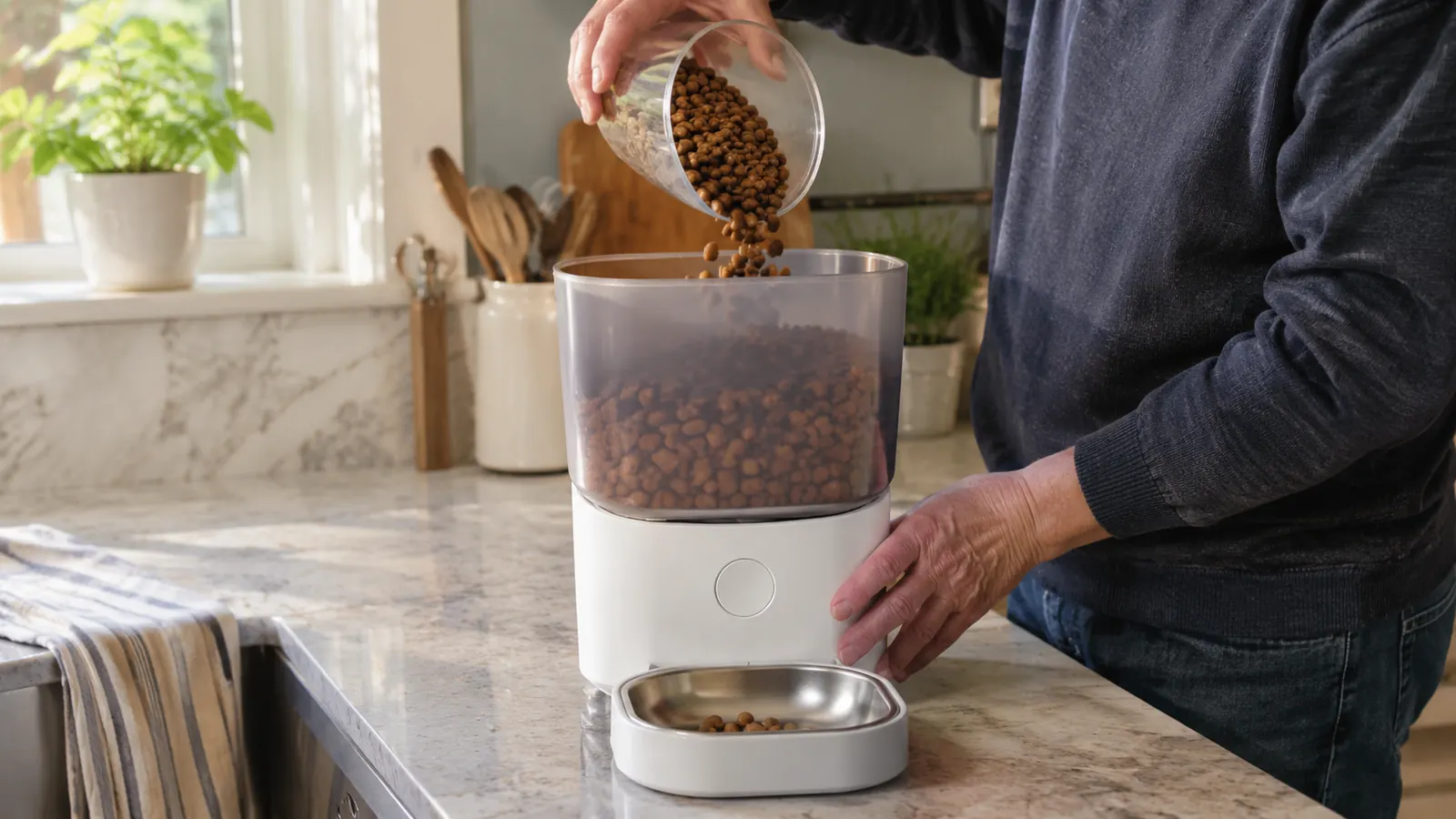
The unit holds 40 ounces of dry food, which in our house works out to roughly a week of the cat's meals. It programs up to five meals a day, and each one gets its own portion size, which you set with the buttons on the front. It runs on four D batteries, and I've learned to keep a fresh set in the drawer, because the low-battery beep has a talent for showing up at midnight.
Setting the schedule took me one confused evening and a second pass through the manual. The programming is straightforward once you accept that each meal is its own little routine: you pick the meal number, set the time, then set the portion, and you do that again for every meal you want. It's a little fiddly the first time, but it's the kind of thing you only learn once, and after that a time change is just two buttons.
The other thing you notice in the first week is the noise. This feeder does not go off silently. There is a mechanical whir while the auger turns, then a clunk as the kibble drops into the bowl, and the sound carries further than you would expect from a plastic box sitting on the floor. By day three Juniper was appearing from wherever she napped the moment the whir started, and I found myself listening for it too, because that sound is how you know the meal actually landed. Nothing in the listing warns you that this machine announces itself, and if your pet is skittish about mechanical noises, it is worth being there for the first few feeds to show them nothing is wrong.
For eight months my routine has been the same. Fill the hopper once a week, wipe the bowl every couple of days, and take the whole thing apart for a real cleaning every three weeks or so. That cleaning cadence is the part I didn't budget for when I ordered it, and it deserves its own section.
The Good: What This Feeder Actually Does Well
The headline feature is that it works. For the first few months I set it, filled it, and forgot about it for days at a time, and it delivered the six o'clock meals on schedule without a single miss. Juniper stopped yowling at my door, Duke stopped camping under the cabinet where her bowl lives, and I stopped feeling guilty every time I left for work before breakfast.
The two-pet angle is where this feeder really earns its keep in our house. Because it doles out a set portion on a set timer, Duke can't get to the cat's breakfast before she does, and Juniper gets her small meal even on the days I'm out of the house by seven. For anyone with a grazer and a hoover under one roof, that alone is worth the price.
The portion control is simple enough for anyone. Each meal is measured by how long the auger runs, which translates into a scoop size you can dial up or down. It's not a scale, and I'll explain why that matters in a minute, but for a daily routine where you glance at the bowl once a day, it's more than accurate enough to keep a cat at a healthy weight.
I should also say the reliability has been genuinely good. In eight months I've had exactly one jam, the one I caused with the oversized kibble, and one low-battery scare. Every other meal, morning and evening, has landed on schedule. That's a better track record than I have with my own alarm clock.
The Bad: Jams, Kibble, and the Quirks Nobody Warns You About
Now the part you came for, the jams. This feeder dispenses by turning an auger that pushes kibble toward the opening, and that works beautifully with medium, round kibble. The trouble starts the moment your kibble is anything else. I ran a bag of large, oddly shaped pieces through it once, the thick medal-shaped sort some premium brands use, and it clogged on day one. At six in the morning, I was taking the whole machine apart on the kitchen floor while Duke watched like it was the best show he'd ever seen.
There's a second, sneakier version of the same problem: small kibble. When the pieces are small and round, the auger tends to overdispense, because a longer run of tiny pieces weighs less than the same run of big ones. That's the volume-not-weight thing. The portion you dial in one week can quietly drift the next week if you switch brands, and the only way to catch it is to weigh the bowl once in a while instead of trusting the dial.
One more honest note on portioning. Because the feeder measures by time, not weight, the same setting can dish out meaningfully different amounts depending on the density of the kibble. A cup of one brand is not a cup of another. That's not a flaw unique to PetSafe, every volume-based feeder works this way, but it's the kind of thing nobody writes in the listing, and it matters if you're portioning for a dog who needs to lose weight.
Here is the step that would have saved me my first morning. The portion dial is a guess until you verify it. The first time you set a serving size, let the feeder dispense into a bowl, then weigh what came out and adjust the dial until it matches your measuring cup. I did this once with a kitchen scale, it took about ten minutes, and it caught a real error, because my first setting was dishing out about a third more than I thought. It is also worth re-checking as the hopper gets low, because a nearly empty hopper feeds a little differently than a full one. That is the drift that sneaks up on you.
The other quirk is that the bowl sits low and the whole unit is light. Duke, who is basically a vacuum with legs, has shoved the feeder a foot across the linoleum going after the last piece of kibble. If your pet is food-obsessed or inclined to knock things over, this feeder needs to sit somewhere it can't be bulldozed, or you need a pet with better table manners than mine.
And while we're being honest, the low-battery beep deserves a mention. The feeder plays a little alert when the D cells are running low, and it always seems to do it at an ungodly hour. It's not loud enough to wake a sleeping adult, but it is exactly loud enough to wake a suspicious cat, which then wakes you. I've learned to just change the batteries on a set day every couple of months instead of waiting for the beep.
Cleaning and Upkeep: The Real Cost of Convenience
Here's the honest trade that's not printed on the box. An automatic feeder is a food-grade machine that touches food every day, so it has to be cleaned like one. The hopper, the auger, the bowl, they all collect dust, kibble crumbs, and a thin film of grease, and if you skip the cleaning for too long, you'll eventually be washing a faint funky smell out of the plastic.
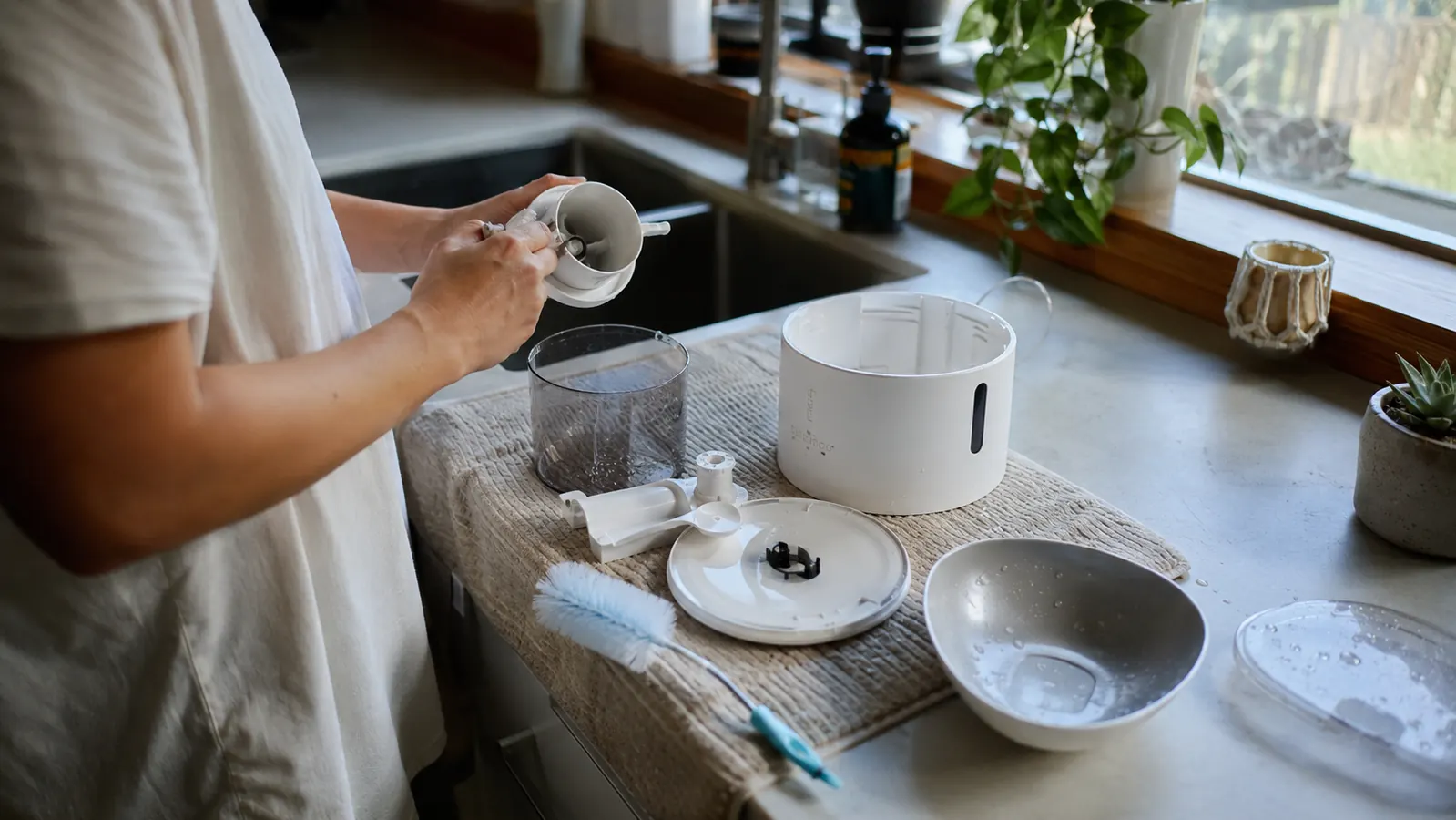
The disassembly isn't hard, but it's more steps than you'd guess. The auger mechanism comes apart into a few pieces, and you have to fish the crumbs out of the channel where the kibble feeds through. I do it at the sink with warm soapy water and a bottle brush, and I let everything dry completely before putting it back together, because reassembling it damp is a fast way to get a sticky auger.
The bowl is the part I actually wash most often. It's a simple plastic bowl that slides out, and on a hot day the kibble oils leave a film that needs a quick soapy rinse. The good news is the bowl is the easy piece. The hopper and auger are the part that takes patience, and the more often you do it, the faster it goes.
The crumbs are the part that tests your patience. The channel where the kibble travels collects dust and tiny broken pieces, and if you do not fish them out they turn into a sticky paste that makes the auger feel rough the next time it turns. I keep a thin bottle brush in the cabinet just for this feeder and run it through the channel every time I clean. Then I let everything dry completely on a towel, because reassembling a damp feeder is a fast way to get fresh kibble stuck to the auger on day one.
Budget about twenty minutes every few weeks and you'll be fine. It's the one ongoing cost of the convenience, and going in knowing that is worth a lot more than finding out the hard way, which is how I found out.
Alternatives I Considered
Before I settled on this PetSafe model, I looked at the smartphone feeders with cameras and companion apps. They're genuinely cool, you can watch your pet eat from your desk and get a notification when the bowl is low. But they cost two to three times as much, and they lean on Wi-Fi, which in my house means they'd be great until the router glitches and the cat goes hungry. I decided I wanted the boring reliable option, and this is it.
I also considered a gravity feeder, the kind that just refills the bowl from a big hopper as your pet eats. It's cheaper and dead simple, but it gives you zero control over portions, which was the whole problem with Duke in the first place. He would have eaten a week's worth in a day and then spent the next six days hungry and furious.
And I briefly looked at the stainless steel feeders, because they're easier to clean and harder for a dog to destroy. They cost more, and for my money the plastic PetSafe is fine as long as you keep up with the cleaning. If you have a chewer, though, that stainless bowl is worth a serious look.
What I Liked
- Delivered scheduled meals on time for months once set up with the right kibble
- 40-ounce hopper holds roughly a week of food for a cat or small dog
- Up to five meals a day with adjustable portions
- Runs on batteries, so a power outage doesn't skip a meal
- Simple controls, no app, no Wi-Fi, no subscription
Where It Falls Short
- Dry kibble only, no wet, raw, or fresh meals
- Jams with large or oddly shaped kibble
- Portions are measured by volume, not weight, so amounts drift across brands
- Cleaning the auger takes real disassembly
- Light and low enough for a determined dog to shove around
The portion you dial in one week can quietly drift the next week if you switch kibble brands. Volume is not weight.
The Honest Bottom Line
So would I buy it again? Yes, and I'd tell a friend the same thing. If you feed dry kibble on a schedule and you don't mind a twenty-minute cleanup every few weeks, the PetSafe 5-meal automatic feeder gives you dependable meals for a price that won't make you wince. Just buy a bag of medium kibble, weigh the bowl once after you switch brands, and find a spot where your dog can't shove it. Do those three things and this feeder will quietly do its job. And I'd add a fourth: listen for the whir at six in the morning, because that sound means the meal landed and nobody in this house had to remember to make it happen.
Who This Is For
This feeder is for the household that feeds dry kibble on a schedule and wants the consistency without the fuss of an app. It's a natural fit for a cat who needs small meals through the day, a small or medium dog on portion control, or anyone who leaves for work before breakfast and hates the guilt of a missed feeding. If that sounds like your house, and you're the practical type who doesn't mind a little upkeep, this is a strong value.
If you're still on the fence, the simplest test is this. Do you feed dry kibble? Do you want the meals to happen at the same time every day even when you're not home? Do you not mind a few minutes of upkeep a week? If you answered yes to all three, this feeder is going to earn its spot on your floor. If you hesitated on any of them, keep reading.
Who Should Skip It
Skip it if your pet eats wet food, raw, or fresh food, because this feeder only handles dry kibble. Skip it if you need precise grams for a dog on a strict medical diet, because volume-based portioning won't give you that accuracy. And skip it if you have a strong, food-obsessed dog who pushes furniture around, because you'll spend more time anchoring the feeder than it saves you. For those situations, a pricier feeder with a stainless bowl and a scale is worth the extra money. And if your pets eat different foods, one on a prescription diet and one on regular kibble, this feeder cannot keep them straight, because it only knows what is in the hopper. The splitting still has to happen at serving time.
And if you're the type who wants to monitor your pet's eating from your phone, or you need a feeder that works with wet food, spend the extra money up front. The PetSafe is a tool, a good one, but it's a tool for a specific job. Buying it for the wrong job is how you end up with a feeder in the back of a closet, which is exactly the waste this site is here to help you avoid.
Ready to put your pets' mealtimes on autopilot?
The PetSafe 5-meal automatic feeder has been the most dependable kitchen gadget in our house for eight months. See today's price on Amazon and decide for yourself.
Amazon Check Today's Price on Amazon →